Warning: Undefined array key "url" in /home/xhvlaua/public_html/wp-content/plugins/seo-by-rank-math/includes/modules/schema/snippets/class-author.php on line 41

Best Roofing Now

Author name: Marblism Auto

Nbkuchg7Vw By Best Roofing Now In North Carolina
Residential Roofing

My Dogs Think They’re Roofers Now (And Why You Should Be Glad They Aren’t)

So I did something ridiculous this week. I took my three dogs, fired up some AI magic, and put them on a roof. Yes, really. And honestly? They looked adorable up there. Tails wagging, tongues out, probably wondering where all the squirrels went. But here's the thing, while my pups make great cuddle buddies and even better alarm systems, they'd be terrible roofers. And that got me thinking about all the "dog" roofers out there in Charlotte and Lake Norman who are just as unqualified to be on your roof. You know the type. The contractors who bark a big game, leave a mess everywhere, and disappear faster than a puppy when you say "bath time." Let me explain. What Exactly Is a "Dog" Roofer? In the roofing world, "dog" has become slang for contractors who are unreliable, sloppy, or downright sketchy. These are the folks who: Show up late (if they show up at all) Give you a "great price" that somehow doubles halfway through Use materials that wouldn't last through one Charlotte thunderstorm Ghost you the second something goes wrong Leave your yard looking like a shingle tornado hit it Sound familiar? You've probably seen them cruising Lake Norman neighborhoods after every hailstorm, knocking on doors with clipboards and promises that sound too good to be true. Because they usually are. My Dogs vs. "Dog" Roofers: A Comparison Let's be real. My three furry goofballs have a lot in common with bad roofing contractors: They're easily distracted. One squirrel sighting and they forget what they were doing. Dog roofers? One better job offer mid-project and they're gone. They make a mess. My dogs track mud everywhere. Dog roofers leave nails in your driveway, shingles in your gutters, and debris scattered across your lawn like confetti. They don't follow instructions. I say "stay." They hear "do whatever you want." Dog roofers hear "building code" and think "building suggestion." They get tired easily. My dogs start strong but quit after 20 minutes. Dog roofers start projects they never finish, leaving you with half a roof and a pile of excuses. They're adorable but useless. My dogs will lick your face all day, but they can't install a ridge vent to save their lives. Dog roofers will sweet-talk you into signing a contract, then deliver work that wouldn't pass a home inspection. The difference? My dogs are at least honest about their limitations. They've never pretended to know the difference between architectural shingles and 3-tab. The "Dog" Roofer Red Flags Charlotte Homeowners Need to Know After seeing hundreds of botched roofing jobs in the Charlotte area, I can spot a dog roofer from a mile away. Here's what to watch for: They don't have local references. Real roofing companies have neighbors who'll vouch for them. Dog roofers just appeared in town last Tuesday. They pressure you to sign TODAY. Legitimate roofers give you time to think. Dog roofers act like your roof will spontaneously combust if you don't sign right now. They want full payment upfront. No reputable contractor asks for 100% before work starts. That's a one-way ticket to Never-See-Them-Again-ville. They can't show proof of insurance. In North Carolina, roofing contractors need liability and workers' comp insurance. Dog roofers get real quiet when you ask for certificates. Their "office" is a cell phone. No website, no physical address, no Google reviews. Just a guy named Chad with a pickup truck and a dream. According to the National Roofing Contractors Association, hiring unlicensed or uninsured contractors is one of the top reasons homeowners end up paying twice for the same roof, once to the dog roofer who disappeared, and again to fix what they broke. What "Good" Roofers Actually Look Like Here's the truth about professional roofing companies: we're not flashy. We're not going to promise you the moon for half the price of everyone else. But we will show up when we say we will. We'll use materials rated for North Carolina weather. We'll pull permits and pass inspections. And we'll clean up after ourselves like adults. At Best Roofing Now, we've built our reputation on doing the opposite of everything dog roofers do: We're veteran-owned and operated. That means we take pride in our work, show up on time, and finish what we start. It's not just a roof, it's our word. We do no-pressure consultations. Seriously. We'll inspect your roof, give you an honest assessment, and let you think about it. If you want to get three more quotes, go for it. We're confident you'll come back. We use magnet sweeps after every job. Because leaving nails in your driveway is just rude. And dangerous. And something my dogs would definitely step on. We're transparent about pricing. You get a detailed estimate upfront. No surprise fees. No "oh, we forgot to mention" charges halfway through. We have actual 5-star reviews from actual Charlotte homeowners. Not Chad's cousin saying he did a "pretty good job." Real people in Cornelius, Huntersville, and Davidson who trusted us with their homes. We've worked through every kind of Carolina weather, from those surprise August thunderstorms that roll off Lake Norman to the occasional ice storm that makes Charlotteans panic-buy bread. We know what roofs in this region need to survive. Why Charlotte Homeowners Keep Getting Burned by Dog Roofers Here's what breaks my heart: I meet homeowners every week who hired the wrong contractor and paid the price. They went with the lowest bid. They skipped checking references. They believed promises that sounded too good to be true. And now they're calling us to fix a roof that's leaking after six months. Or dealing with insurance companies who won't cover damage caused by improper installation. Or staring at a half-finished job because the contractor vanished. One homeowner in Mooresville told me she hired a guy who promised a full roof replacement for $8,000, about 40% below market rate. He took a $4,000 deposit, showed up for two days, then stopped returning her

By Best Roofing Now In North Carolina
Residential Roofing

5. The "Elevator Ride" Pricing Scam Have you ever heard of the "Elevator Ride"? It is a trick some sales guys use. First, they give you a very low price. It sounds like a steal! You sign the contract. Then, they start the work. They tear off your old shingles. Now your roof is open. Suddenly, the foreman comes down. He looks worried. He says, "Oh no, we found rotten wood." Or he says, "The price of metal just went up today." Suddenly, that low price starts going up. It goes up and up, just like an elevator. They know you can't say no. Your roof is half-gone! You have to pay. A local pro like us does things differently. We do a deep roof inspection before we ever give you a price. We look in the attic. We check the deck. We try to find every problem before we start. If we find something weird later, we talk to you about it honestly. We don't use tricks to get more money. 6. Cheap Materials vs. Quality Brands Storm chasers want to make the most money possible. They use the cheapest shingles they can find. These shingles might look okay for a year. But they won't last. They might blow off in the next wind storm. They might lose their granules (the tiny rocks on top) very fast. We are certified with the best brands in the world. We use GAF and CertainTeed products. These are not just shingles. They are systems. GAF Shingles: They have special layers to fight wind and rain. CertainTeed: Known for being the heaviest and strongest shingles you can buy. Ice and Water Shield: A sticky barrier we put in the valleys. It keeps water out even if ice builds up. When you use a GAF Certified roofer, you get a better warranty. Storm chasers can't give you these warranties. If their work fails, you are on your own. If our work has a material issue, the manufacturer stands behind us. 7. They Skip the Details Roofing is about more than just shingles. It is about the "jewelry" of the roof. This means the flashing, the vents, and the pipe boots. Flashing is the metal that goes around your chimney or in the corners. It keeps water from leaking into the walls. Storm chasers often reuse old flashing. It is rusty and full of holes. They just cover it with caulk. In a year or two, that caulk dries out. Then you have a leak. We replace the flashing. We check the gutters and siding too. We make sure the whole system is solid. We even look at your attic ventilation. Did you know that if your attic is too hot, it can bake your shingles from the inside? A storm chaser won't tell you that. They just want to slap on shingles and leave. 8. The Veteran-Owned Difference I am proud to be a veteran. In the military, I learned about honor. I learned about integrity. I learned that you never leave a man behind. I run my business the same way. When we say we will do something, we do it. We don't cut corners. We treat your home like it is our own. Many door-to-door teams are just out for a quick buck. They don't care about the community. We do. We support local veterans in Charlotte. We help our neighbors. When you hire a veteran-owned roofing company, you are hiring someone who values their word. 9. Charlotte Weather and Local Codes Every area has different rules for building. Charlotte and Lake Norman have specific codes. These codes are there to keep you safe. For example, we have high humidity here. We have big storms. A roofer from another state might not know our local rules. They might use the wrong nails. They might not put enough vents in. We know the Charlotte building codes inside and out. We pull the right permits. We make sure the city inspectors are happy. If you ever sell your house, you will need proof that the roof was done right. A storm chaser won't give you that paperwork. 10. The Lifecycle of a "Storm-Chaser Roof" Let's look at what happens to a roof installed by a door-to-door salesman. Year 1: The roof looks great. You are happy. You saved some money on your deductible.Year 2: A small leak starts around the chimney. You call the number on the contract. No one answers.Year 3: The shingles start to curl. You realize they didn't install the right ventilation.Year 5: Half the shingles blow off in a summer storm. You call a local company (like us).The Bad News: We have to tell you the roof was installed poorly. The warranty is void because of bad work. Now you have to pay for a whole new roof. This is the sad truth. A "free" roof from a storm chaser often ends up costing you twice as much in the long run. 11. Your "Stop the Scam" Checklist Next time someone knocks on your door, use this list. Don't be afraid to be firm. It is your house! Ask for a Physical Address: Is it in Charlotte? Go look it up on Google Maps. Is it a real office or a parking lot? Check for a License: Do they have a North Carolina contractor's license? Ask for References: Can they show you a project in Lake Norman or Dilworth that they did two years ago? No Signatures Today: Never sign a "contingency agreement" on the first day. This is a contract that hooks you. Look at the Truck: Do they have local plates? Is the company name on the door? Call Your Insurance First: If you think you have damage, call your insurance company yourself. Don't let the salesman do it for you. 12. What a Professional Inspection Looks Like When you call Best Roofing Now, here is what happens. We don't just show up. We set an appointment.

Lmqrfrhsu4D By Best Roofing Now In North Carolina
Residential Roofing

Roofing Craftsmanship Secrets Revealed: What Experts Don’t Want You to Know About Long-Term Durability

Most people think a roof is just a pile of shingles on a house. You see a nice color. You see straight lines. You think the job is done right. But as a roofer in Charlotte for many years, I can tell you a secret. The real "magic" happens where you can't see it. It is like an iceberg. Only 10% is above the water. The other 90% is under the surface. That 90% is what keeps your home dry during a Lake Norman summer storm. At Best Roofing Now, we believe you should know what goes into a high-quality roof. We are veteran-owned and operated. That means we care about the mission. Our mission is to protect your family and your biggest investment. Today, I am pulling back the curtain. I want to show you the "craftsmanship secrets" that separate a 30-year roof from a 10-year disaster. And, let's be honest, many companies just want to get the job done fast and leave. But we take a different approach. We want you to understand the "why" behind every nail and every layer. The Secret of the "Golden" Nailing Zone Did you know that where a roofer puts a nail can change everything? It sounds small, I know. But it is one of the biggest secrets in the industry. Every shingle has a "nailing zone." This is a thin strip, usually about an inch wide. If the nail goes in that strip, the shingle stays put. If it goes too high, the nail might only catch one layer of shingle. If it goes too low, the nail head will show. In Charlotte, we get high winds. When a wind gust hits a roof, it creates "uplift." If the nails are "high-nailed" (placed above the line), the shingle can pull right off. It’s like trying to hold a piece of paper by just the very edge. Most homeowners never see this. They just see shingles on the ground after a storm. We use a 6-nail pattern for our residential roofing projects. Most codes only require 4 nails. Why do we do 6? Because it increases the wind rating. It makes your roof much stronger. It is the difference between worrying during a storm and sleeping like a baby. The "Second Roof": Underlayment and Barriers If you take off the shingles, what do you see? In the old days, roofers used "felt paper." It was basically paper soaked in tar. It worked okay, but it tore easily. Today, we use synthetic underlayment. This is a tough, plastic-like fabric. It doesn't tear. It doesn't absorb water. It is a "second roof" that protects your house if a shingle ever blows away. But here is the real secret: Ice and Water Shield. Even in Charlotte, where we don't get tons of ice, this stuff is vital. It is a sticky, rubbery membrane. We put it in the "valleys" (where two roof sections meet) and around chimneys. When you drive a nail through it, the rubber seals around the nail. It makes it 100% waterproof. Many roofers skip this to save money. Or they only use a little bit. We use it everywhere it matters. We want to make sure your roof is a sealed system. According to the National Roofing Contractors Association (NRCA), water management is the most important part of a roof's life. Why Your Roof Needs to "Breathe" Heat is the #1 killer of roofs in North Carolina. Our summer sun is brutal. If your attic gets too hot, it cooks your shingles from the inside out. They get brittle. They lose their granules. They die years before they should. The secret to a long-lasting roof is ventilation. Think of your attic like a pair of lungs. It needs to breathe in cold air and breathe out hot air. We use "intake vents" at the bottom (near the gutters) and "exhaust vents" at the top (the ridge). If a roofer doesn't balance these, your attic stays a sauna. A lot of guys just throw on a ridge vent and call it a day. But if the intake vents are blocked by insulation, that ridge vent does nothing. We check your "soffit vents" every single time. It is part of our free inspection and consultation process. Flashing: The Jewelry of Your Roof Flashing is the metal trim you see around chimneys and where the roof meets a wall. I call it the "jewelry" because it should look clean and bright. But its job is much more important. It directs water away from the most dangerous spots on your house. The secret? Never reuse old flashing. Some companies will try to save a buck by leaving the old metal there. They just put a bunch of caulk over it. Here is a rule you can take to the bank: Caulk is not a repair. Caulk dries out. It cracks in the Charlotte sun. We use "step flashing." This means every shingle has its own piece of metal tucked under it. Then we put "counter-flashing" over that. It creates a double barrier. If water gets past one, it hits the other. It is a classic move that true craftsmen use. The Truth About Decking The decking is the wood (plywood or OSB) that your shingles are nailed to. You can't see it once the roof is on. This is where "tailgate roofers" hide their secrets. If the wood is soft or rotted, they might just shingle right over it. Why is that bad? Because nails won't hold in rotted wood. It’s like trying to nail into a sponge. The first big wind will pull those shingles right off. Also, rotted wood can lead to mold in your attic. When we do a roof repair or replacement, we walk every inch of that deck. If we find a soft spot, we replace it. We want a solid foundation. You wouldn't build a house on sand, right? So don't put a roof on bad wood. CertainTeed
Ii4Oiuxajmx By Best Roofing Now In North Carolina
Residential Roofing

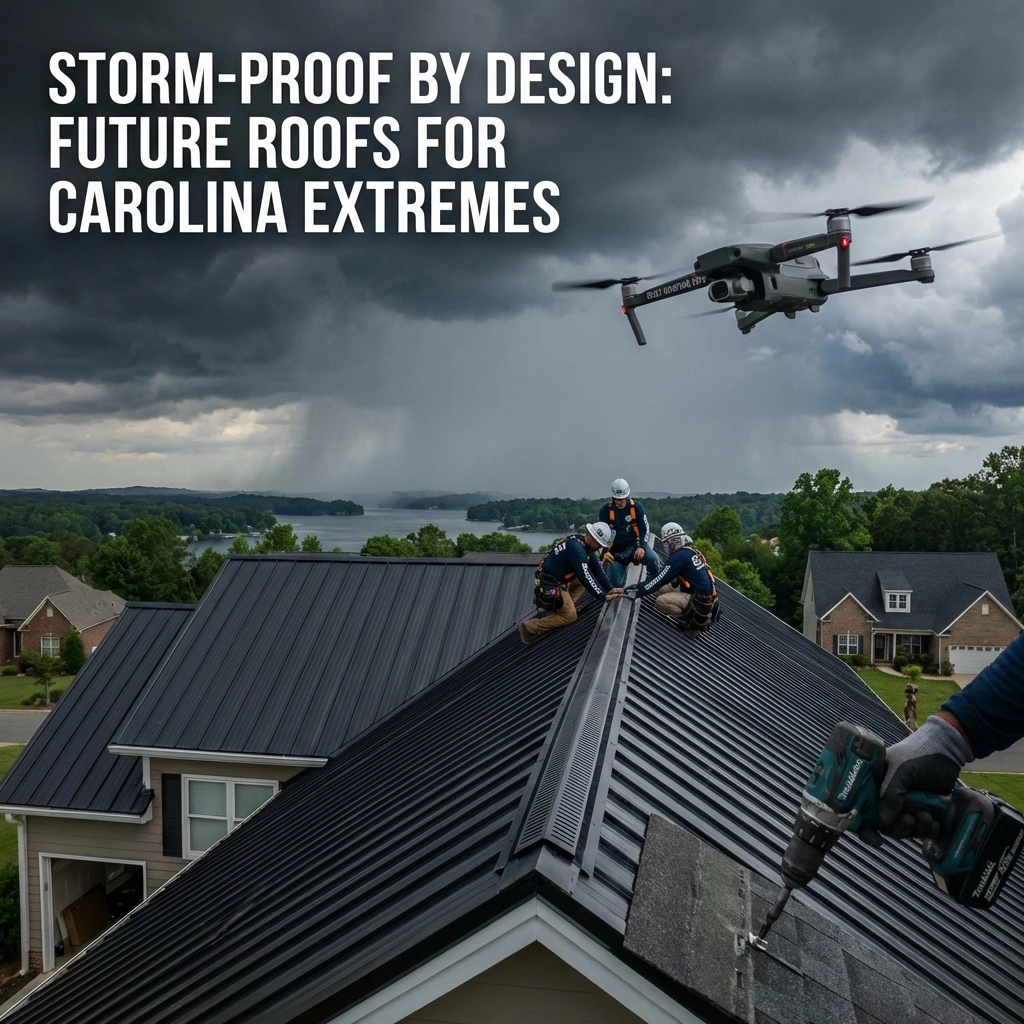
Storm-Proof by Design: Why Future Roofs Will Be Built for Carolina Weather Extremes

Mother Nature isn't getting gentler with Carolina homeowners. If anything, she's throwing bigger punches each year. As someone who's climbed onto hundreds of roofs after storms in Charlotte and Lake Norman, I can tell you this: the roofs we're installing today won't cut it for tomorrow's weather. We're entering an era where "good enough" roofing will leave families with buckets in their living rooms and insurance claims that never fully cover the damage. But here's the exciting part – the future of roofing is already here. We're seeing materials and designs that can laugh at 150+ mph winds and shrug off golf ball-sized hail. The question isn't whether storm-proof roofing will become standard in the Carolinas. It's whether you'll be an early adopter or wait until the next hurricane forces your hand. Why Carolina Weather Demands a New Approach Let me paint you a picture of what we're up against. Hurricane season runs from June through November, and we're seeing storms that would have been once-in-a-lifetime events becoming regular visitors. Category 1-4+ hurricanes with winds exceeding 150 mph aren't just hitting the coast anymore – they're making their way inland to Charlotte, Huntersville, and Davidson with enough punch to turn traditional roofing materials into projectiles. But hurricanes aren't our only enemy. We're dealing with: Severe thunderstorms that pop up with little warning, bringing microbursts that can hit your neighborhood with 100+ mph winds while leaving the house next door untouched Hail storms that seem to target expensive neighborhoods like Cornelius and Matthews with ice chunks the size of softballs Extended heavy rain periods that test every seal, flashing, and joint on your roof for weeks at a time Temperature swings that make roofing materials expand and contract like they're breathing Traditional roofing systems designed for moderate climates simply weren't built for this kind of abuse. A standard asphalt shingle roof might handle a Category 1 hurricane if you're lucky. But when that Category 3 storm decides to park over Lake Norman for six hours, that's when we get the phone calls that no homeowner wants to make. The Materials Revolution is Here The future of storm-proof roofing starts with materials that treat extreme weather as a design requirement, not an afterthought. Standing seam metal roofing is leading this revolution. When properly installed, these systems can withstand wind speeds exceeding 140 mph – some manufacturers are now rating their products for 180+ mph winds. The secret lies in the continuous panels with interlocking seams and concealed fasteners. There are no tabs for wind to grab, no exposed nails to work loose, and no vulnerable points where Mother Nature can get a grip and start peeling your roof away like opening a sardine can. I've inspected metal roofs after severe storms that looked like they were installed yesterday, while the neighboring houses needed complete replacements. The difference isn't luck – it's engineering. Concrete and clay tiles represent another quantum leap forward. When mechanically fastened (not just laid in place like the old days), concrete tiles can handle winds of 150+ mph and rain so heavy it sounds like a freight train on your roof. Their weight and interlocking design create a fortress-like barrier that doesn't just resist storm damage – it actively fights back against it. But here's where it gets really exciting: manufacturers aren't stopping there. We're seeing new composite materials that combine the best properties of multiple materials into single products. Imagine shingles with the wind resistance of metal, the impact resistance of concrete, and the aesthetic flexibility of traditional asphalt – all while weighing less than any of them individually. Shape Matters: The Geometry of Survival Most homeowners focus on roofing materials and forget about the shape of their roof. Big mistake. Hip roofs – which slope on all four sides – dramatically outperform gable roofs in extreme weather. Why? Wind flows over them like water over a river stone. There are fewer edges where high winds can catch and lift, and the aerodynamic shape actually helps channel wind away from vulnerable areas. Gable roofs, especially those with large overhangs, are like putting up a sail in a hurricane. The wind hits that vertical gable end and has nowhere to go but up and over, creating massive uplift forces that can tear sections of roof off in one piece. If you're building new or considering a major renovation, roof geometry should be part of your storm-proofing strategy. It's not just about looking good – it's about physics and survival. FORTIFIED: The New Gold Standard Here's something most homeowners don't know: there's now a certification program that can cut your insurance premiums while making your home exponentially more storm-resistant. FORTIFIED certification ensures roofs meet enhanced protection requirements that go way beyond standard building codes. This includes: Sealed roof decks with underlayment systems that prevent water intrusion even if the outer roofing material fails Edge metal secured to withstand high winds (because wind damage often starts at the edges and works inward) Roof coverings that meet high-wind standards with proper attachment methods The certification process involves professional assessment, quality materials, proper installation, and ongoing maintenance requirements. It's like having a PhD in storm resistance for your roof. Insurance companies love FORTIFIED roofs because they result in fewer claims. Many insurers now offer premium discounts of 10-15% for FORTIFIED-certified homes. In hurricane-prone areas, that discount can pay for the certification process within a few years. Technology Integration: Smart Roofing for Smarter Protection The future of storm-proof roofing isn't just about tougher materials – it's about intelligence. We're starting to see sensor systems that monitor roof performance in real-time. Imagine getting a text alert that your roof has detected potential damage from last night's storm, complete with GPS coordinates of the affected area. Or sensors that measure wind uplift forces and can predict when maintenance is needed before problems develop. Some manufacturers are developing "self-healing" roofing materials that can seal minor damage automatically. While this technology is still emerging, the early results

Uhixf1Ssmzt By Best Roofing Now In North Carolina
Residential Roofing

Are You Making These Common Charlotte Roofing Mistakes During Storm Season?

Charlotte weather is a bit of a wild ride. One minute you are enjoying a clear sky over Lake Norman. The next minute, a wall of dark clouds rolls in from the west. If you have lived here for a while, you know our "storm season" isn't just one month. It is a constant cycle of high heat, thick humidity, and sudden, heavy downpours. Most homeowners think about their roof only when they see a drip in the living room. But by then, the damage is already done. At Best Roofing Now, we see the same mistakes over and over again. These aren't just small slips. They are mistakes that can cost you thousands of dollars. They can turn a simple repair into a full roof replacement. And honestly? Most of them are totally avoidable. We want to help you stay ahead of the weather. As a veteran-owned business, we believe in doing things right the first time. We want to share some hard-earned knowledge to keep your home safe. Here are the most common roofing mistakes Charlotte homeowners make during storm season and how you can fix them. 1. The "Wait and See" Inspection Approach The biggest mistake we see is people waiting for a leak to call us. We get it. Life is busy. But in the roofing world, "no news" is not always "good news." Charlotte gets a lot of hail. Sometimes the hail is small. It might not break a window or dent your car. But it can still "bruise" your shingles. Think of a shingle like a piece of fruit. If you drop an apple, it might look fine on the outside. But a few days later, a soft, brown spot appears. On a roof, hail knocks off the tiny granules that protect the shingle from the sun. Once those granules are gone, the sun's UV rays bake the asphalt underneath. It gets brittle. It cracks. Then, the next big thunderstorm hits, and water finds its way into your attic. What to do instead: Get a free roof inspection before the heavy storms hit. We use drones and professional tools to find those "bruises" before they turn into leaks. It is much easier to fix a few shingles than to replace an entire section of rotted wood. 2. Ignoring the "Bake and Rot" Attic Humidity This is a big one for the Lake Norman area. Our humidity is no joke. Most people think a roof's job is just to keep rain out. But your roof also needs to let air out. Many Charlotte homes have what we call "one-way" ventilation. They might have vents at the top of the roof, but not enough intake vents at the bottom (soffits). This traps hot, moist air in your attic. During a humid North Carolina summer, your attic can reach 150 degrees. This heat "bakes" your shingles from the inside out. It makes them curl and lose their seal. Even worse, that trapped moisture can turn into condensation. It literally "rains" inside your attic. This leads to mold, wood rot, and rusted nails. "In Charlotte and Lake Norman, your roof isn’t just fighting storms: it’s fighting heat and humidity every single day, which can be just as destructive as a single big hail event," says the team at Best Roofing Now. What to do instead: Ask for a ventilation check. A balanced system uses the 1:150 rule. You need 1 square foot of vent space for every 150 square feet of attic. It should be split 50/50 between intake and exhaust. This keeps your roof cool and your energy bills lower. 3. Hiring "Storm Chasers" Instead of Local Pros After a big storm hits neighborhoods like Ballantyne or Huntersville, you will see trucks with out-of-state plates. These are "storm chasers." They follow the hail. They offer "free roofs" and promise to handle everything with your insurance. The problem? They are gone as fast as they came. If your new roof leaks in six months, good luck finding them. They often use cheap materials and rush the job. They might skip the drip edge or use low-quality felt paper. What to do instead: Stick with a local, veteran-owned company. We live here. We work here. Our kids go to school here. We offer lifetime warranties because we know we will be here to honor them. Look for BBB accreditation and certifications from leaders like GAF or CertainTeed. 4. The "Cheapest Bid" Trap We all want to save money. But your roof is the most important part of your home’s structure. Choosing the cheapest bid usually means you are getting the thinnest shingles and the most basic underlayment. In the Charlotte region, we deal with "microbursts": sudden, very strong winds. A cheap 3-tab shingle is only rated for about 60 mph winds. Many architectural shingles, like those from GAF or CertainTeed, are rated for 130 mph. If you go cheap, you might save $1,000 today. But you will spend $10,000 later when the wind strips those shingles off like a deck of cards. What to do instead: Think about "Total Value." Look for high-wind ratings and impact resistance. We often recommend GAF Timberline HDZ or CertainTeed Landmark shingles. They are built for the humidity and wind we see in the Carolinas. 5. Neglecting the Gutter System Your gutters are actually part of your roofing system. When they get clogged with pine needles and leaves, water backs up. In a heavy Charlotte downpour, that water can push up under your shingles. This causes the "fascia" (the wood behind the gutter) to rot. It can also cause leaks along the edge of your roof. Many homeowners blame a "roof leak" when the real problem is just a clogged gutter. What to do instead: Clean your gutters at least twice a year. If you have a lot of trees, you might need to do it more. Make sure the water is flowing at least five feet away from your foundation. If your

Cgxqdohyyue By Best Roofing Now In North Carolina
Residential Roofing

The Ultimate Guide to Roofing Insurance Claims: Everything You Need to Succeed in Charlotte

Storms in North Carolina are no joke. One minute you’re enjoying a quiet evening in Dilworth or a sunny afternoon out on Lake Norman, and the next, the sky turns that eerie shade of green. Thunder rolls, wind howls, and then you hear it: the rhythmic thwack of hail hitting your roof. When the clouds clear, you’re left with more than just a wet driveway. You’re left with questions. Is my roof okay? Will my insurance cover this? How do I even start a claim? At Best Roofing Now, we’ve seen thousands of homeowners in Charlotte and the surrounding areas go through this exact stress. We know that the insurance process can feel like a maze designed to keep you from getting what you need. But here’s the visionary truth: a storm isn’t just a disaster; it’s an opportunity to restore your home’s protection and value with the latest roofing technology. This guide is your roadmap. We’re going to walk through every single step of the roofing insurance claim process in North Carolina. No jargon. No high-pressure sales. Just the facts you need to protect your biggest investment. Phase 1: The Immediate Aftermath (The First 24 Hours) The storm has passed. The rain has stopped. Your first instinct might be to grab a ladder and climb up there yourself. Don't do it. North Carolina roofing safety is a priority for a reason. Damaged roofs can be slippery, unstable, and incredibly dangerous. Instead, keep your feet on the ground and follow these steps. 1. The Ground-Level Walkthrough Walk around your house and look for the obvious signs. Are there shingles in the grass? Do your gutters have "bruises" or dents? If you see metal vents on your roof that look like they’ve been hit with a hammer, that’s a clear sign of hail. 2. Check the "Soft Metals" Hail often leaves its mark on things softer than shingles first. Check your downspouts, window screens, and even your grill or mailbox. If those are dented, your roof likely took a beating too. 3. Look Inside Head up to your attic with a flashlight. Look for dark spots on the wood or damp insulation. Check the ceilings in your top-floor rooms. Sometimes a storm-damaged roof doesn't leak immediately, but catching a "slow drip" now saves you from a massive mold bill later. 4. Document Everything Take photos of everything you see. And I mean everything. Use your phone to snap pictures of the hail on the ground (maybe hold a coin next to it for scale), the debris in your yard, and any visible damage to your siding or gutters. Phase 2: Why the Professional Inspection Matters You’ve seen some signs of damage, but insurance companies need more than just "I think it's broken." They need proof. This is where a professional, local Charlotte roofer comes in. At Best Roofing Now, we offer free inspections because we believe you deserve to know the truth about your roof without paying a dime upfront. We use a consultation-based approach. We aren't here to "sell" you: we’re here to evaluate. The "Shadow Damage" Problem Not all roof damage is visible to the untrained eye. Hail can cause "bruising" on asphalt shingles. This is when the impact breaks the fiberglass mat underneath the granules. You might not see a hole, but that shingle is now compromised. Over the next few months, the NC humidity and sun will bake that spot, and eventually, it will fail. As the experts at GAF point out: “A professional roofer can help identify damage… providing receipts, photos, and a list that confirms the value and description of roof and exterior damage will help the claims process run smoothly.” When we inspect your roof, we mark these areas with chalk to document the frequency and severity of the hits. This creates a visual "map" for the insurance adjuster to follow. Phase 3: Decoding Your Insurance Policy Before you call your agent, you need to know what kind of coverage you actually have. In North Carolina, most policies fall into two categories: 1. Replacement Cost Value (RCV) This is the "gold standard." If your roof is damaged, the insurance company pays to replace it at today’s prices. You only pay your deductible. They might hold back some money (called "depreciation") until the work is actually finished, but eventually, they cover the full cost. 2. Actual Cash Value (ACV) This is a bit tougher. With ACV, the insurance company only pays for what your roof is worth right now. If your 20-year roof is 15 years old, they’ll deduct 75% of the value for "wear and tear." This often leaves homeowners with a large out-of-pocket bill. Wait, what about my deductible?Your deductible is the amount you agreed to pay before insurance kicks in. In Charlotte, we see deductibles ranging from a flat $1,000 to 1% or 2% of the home's total value. But remember: it is illegal for a roofing contractor to "waive" or pay your deductible in North Carolina. If a "storm chaser" offers to do this, run the other way. That’s insurance fraud, and it puts you at risk. Phase 4: Filing the Claim (The Right Way) Once we’ve confirmed there is significant damage, it’s time to file. You can usually do this online or over the phone. What you'll need: Your policy number. The date of the storm (we can help you pinpoint this using weather tracking software). Our inspection report and photos. The "Storm Chaser" WarningAfter a big hail storm in neighborhoods like Ballantyne or Huntersville, you'll see trucks with out-of-state plates everywhere. These are "storm chasers." They follow the hail, sign as many contracts as possible, and then disappear. But as a veteran-owned business right here in Charlotte, we live here. We work here. We stand by our lifetime warranties. And we know that your roof needs to handle the specific "NC Mix": that combination of high humidity, sudden ice storms, and baking summer heat. Phase 5: Meeting the
Bttqcc9P9Ws By Best Roofing Now In North Carolina
Residential Roofing

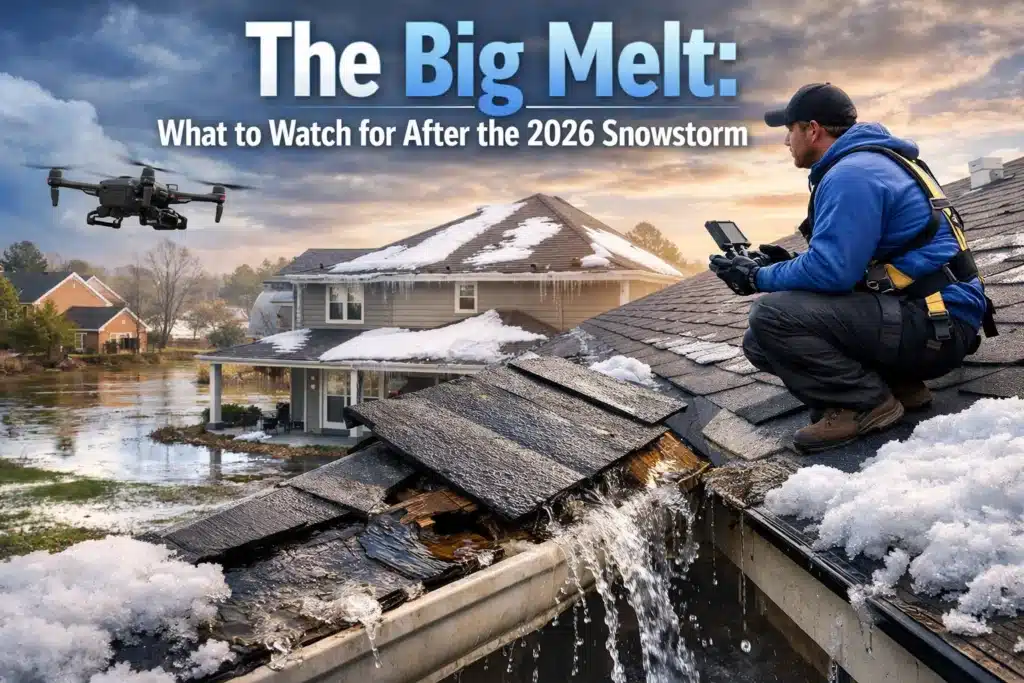
The Big Melt: What to Watch for After the 2026 Snowstorm

So here we are. Charlotte just lived through the worst snowstorm in decades. If you're reading this, you probably spent the last week digging out your driveway, checking on neighbors, and wondering if your roof was going to hold up under all that white stuff. Good news: Most roofs did just fine. The real test? It's happening right now. Because all that snow has to go somewhere. And when it melts, that's when the hidden problems show up. The Warming Trend Is Here (And It's Fast) The National Weather Service is calling for temps in the 50s and 60s across Charlotte and the surrounding areas. That's a massive swing from the single-digit wind chills we saw just days ago. By mid-February, we're looking at above-average temperatures sticking around for a while. Here's what that means for your roof: Every inch of snow that's been sitting up there for the past week is about to turn into water. A lot of water. Fast. And when water moves fast, it finds every weak spot in your roofing system. Where Does All That Water Go? Let's walk through what happens when snow melts on your roof. It's not as simple as "down the gutters and away." The snow on your roof doesn't melt evenly. The parts closest to your warm attic melt first. That creates a layer of water between the snow and your shingles. If your gutters are clogged (and after this storm, most of them are), that water backs up under the shingles. This is how you get water in your attic even though you don't have any visible damage. The water also refreezes overnight when temps drop. That's where ice dams come in. And ice dams are one of the biggest threats to your roof during the melt. Ice Dams: The Hidden Damage Maker An ice dam is a ridge of ice that forms at the edge of your roof. It happens when melting snow runs down and refreezes at the cold eaves. Once that dam forms, water backs up behind it. And it has nowhere to go but under your shingles. That's when you start seeing water stains on your ceiling, wet insulation in your attic, and sometimes even water running down your interior walls. The National Roofing Contractors Association says ice dams are responsible for millions of dollars in damage every winter. Most homeowners don't even know they have one until they see water inside. Here's how to spot an ice dam: Icicles hanging from your gutters (especially large ones) Ice buildup along the edge of your roof Water stains on your ceiling near exterior walls Sagging or wet spots in your attic insulation If you see any of these, you need to act fast. The longer water sits under your shingles, the more damage it does. What NOT to do: Don't climb up there with a hammer or ice pick. You'll punch holes in your roof faster than the ice dam will. And don't use a pressure washer. The force can lift shingles and cause more leaks. What TO do: Call us for a free inspection. We've seen hundreds of ice dams across Charlotte and Lake Norman. We know how to safely remove them without damaging your roof. Your Gutters Are Working Overtime (Or Not Working At All) Let's be honest. When was the last time you cleaned your gutters? After a storm like this, your gutters are probably packed with leaves, pine needles, ice, and debris. That means all the meltwater has nowhere to go. It overflows and runs down your siding, pools near your foundation, or backs up under your shingles. Check your gutters now while temps are above freezing. Look for: Standing water in the gutters Ice chunks blocking the downspouts Gutters pulling away from the fascia Water overflowing during the next rain If your downspouts are frozen solid, you've got a problem. Melting snow has to drain somewhere. If it can't go down, it goes sideways: right into your home. One trick: Pour warm (not boiling) water down the downspout to break up ice blockages. But if you've got major damage or sagging gutters, call a pro. We offer roof repair services that include gutter work. The Hidden Leaks That Show Up Later This is the part that frustrates homeowners the most. You might not see a leak today. Or tomorrow. But two weeks from now, you notice a brown stain spreading across your bedroom ceiling. What happened? The water got in during the melt. But it took time to soak through insulation, travel along roof decking, and finally drip through the drywall. By the time you see it, the damage has been happening for days. Here's where to look for hidden leaks: In Your Attic: Dark streaks or stains on the underside of the roof decking Wet or compressed insulation Mold or mildew smell Daylight coming through the roof boards On Your Ceilings: New water stains (usually yellow or brown) Bubbling or peeling paint Sagging drywall Around Your Chimney: Water stains on the brick or siding near the chimney Dampness in the fireplace Rust on the damper If you spot any of these, don't wait. Water damage gets expensive fast. The average cost to repair water damage from a roof leak runs into the thousands. But catching it early? That's usually a simple repair. We've written a detailed guide on how to tell if your roof needs emergency repair after a storm that walks through all the warning signs. Ventilation Matters More Than You Think Your attic ventilation plays a huge role in how well your roof handles the melt. Poor ventilation traps warm air in your attic. That warm air melts the snow from underneath, which speeds up ice dam formation. A properly ventilated attic stays cold. That means snow melts slowly and evenly, giving your gutters time to drain it away. Walk outside and look at your neighbors' roofs. See one that's completely clear while others still have snow?

4H6Yn Rgnkt By Best Roofing Now In North Carolina
Residential Roofing

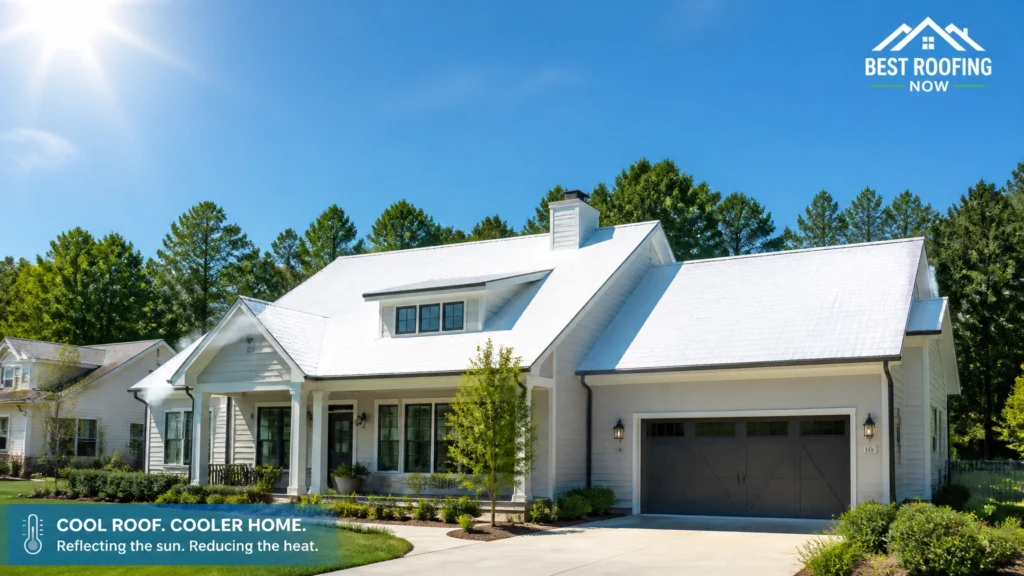
Why Reflective ‘Cool Roofs’ Will Change the Way You Handle Charlotte Summers

If you live in Charlotte, you know the "summer sizzle." It is that moment when you step outside in July, and the air feels like a warm, wet blanket. Your air conditioner hums 24/7. Your power bill creeps higher every month. At Best Roofing Now, we see this every single year. I am James Turner, and I have spent years looking at roofs across the Queen City and Lake Norman. I have realized something important. Most of our roofs are working against us. They are soaking up the sun and turning our attics into ovens. But there is a better way. It is called a "cool roof," and it is changing the game for North Carolina homeowners. The Problem: Your Roof is a Giant Space Heater Think about your roof for a second. Most roofs in neighborhoods like Myers Park or Ballantyne are dark gray or black. On a sunny 90-degree day, that dark shingle can reach 150 degrees or more. That is hot enough to fry an egg. When your roof gets that hot, the heat has nowhere to go but down. It seeps through the roof deck. It sits in your attic. Even with good insulation, that heat eventually pushes into your living space. Your AC has to fight a war it cannot win. This makes your house less comfortable. It also makes your equipment wear out faster. We see AC units in Charlotte die years early because they never get a break. What Exactly is a ‘Cool Roof’? A cool roof is not just a roof that looks cool, though they do look great! It is a roof designed to do two things very well: reflect sunlight and emit heat. Imagine wearing a black t-shirt on a summer day. You get hot fast, right? Now imagine wearing a white t-shirt. You feel much better. A cool roof is like a white t-shirt for your house. But here is the best part: modern technology means your roof does not have to be bright white to be "cool." Companies like GAF and CertainTeed have created shingles that look like normal, beautiful architectural shingles but reflect the sun like a mirror. 1. Solar Reflectance This is the roof's ability to bounce sunlight back into the sky. Most standard shingles absorb about 90% of the sun's energy. Cool shingles are different. They use special granules that act like tiny mirrors. They can reflect a huge chunk of that energy before it ever turns into heat. 2. Thermal Emittance This is a fancy term for how well the roof "shrugs off" heat. If a roof does get warm, a high-emittance roof releases that heat quickly. It does not hold onto it like a cast-iron skillet. This keeps your attic much cooler after the sun goes down. Why Charlotte is the Perfect Place for This Tech Charlotte is unique. We have a "humid subtropical" climate. Our summers are long, and our winters are usually mild. This means we spend way more money cooling our homes than heating them. According to the Department of Energy, cool roofs work best in climates like ours. In a place like Charlotte, a cool roof can cut your summer cooling costs by 10% to 30%. If your monthly Duke Energy bill is $200 in the summer, you could be saving $40 or $60 every single month. Over the 25-year life of a roof, that is thousands of dollars back in your pocket. The Materials: Choosing Your Shield At Best Roofing Now, we don't believe in high-pressure sales. We believe in options. When it comes to cool roofs, there are two big names that we trust: GAF and CertainTeed. GAF Timberline CS (Cool Series) GAF is a leader in roofing for a reason. Their Cool Series shingles are designed specifically for high-heat areas. They use highly reflective granules. This helps reduce the temperature in your attic. GAF claims these shingles can help reduce your cooling costs significantly. Plus, they come with the same great looks and warranties as their standard Timberline shingles. CertainTeed Landmark Solaris CertainTeed is another heavy hitter. Their Solaris line is a solar-reflective architectural shingle. It is cool-roof rated by the Cool Roof Rating Council (CRRC). What I love about Solaris is the color depth. You can get rich, dark-looking colors that still meet cool roof standards. It is the best of both worlds: style and science. The Hidden Benefits: More Than Just Savings Most people look at the energy bill first. But as a roofer, I look at the structure. A cool roof does more than save money. It saves your house. 1. Longer Roof Life Heat is the #1 enemy of a roof. High temperatures cause shingles to bake and become brittle. When a roof expands and contracts too much because of heat spikes, it wears out. By keeping the temperature steady, a cool roof can actually last longer than a traditional dark roof. 2. Less AC Repairs When your AC has to work 20 hours a day, parts break. Fans die. Compressors fail. By reducing the "heat load" on your house, your AC system can take more breaks. This means fewer emergency calls to the HVAC guy in August. 3. Helping the Neighborhood Have you ever walked from a grassy park into a big parking lot and felt the temperature jump 10 degrees? That is the "Urban Heat Island" effect. Charlotte is growing fast. All those dark roofs and black roads trap heat. If more homes in Charlotte used reflective roofing, our whole city would stay cooler. It is a small way to give back to the community we love. The "Winter Penalty" Myth I often hear homeowners ask, "But James, won't a cool roof make my house colder in the winter? Won't I pay more for heating?" This is a fair question. In the winter, you want some heat from the sun. But here is the truth for North Carolina: The sun is lower in the sky during winter. Your roof

Uhrigtgzvth By Best Roofing Now In North Carolina
Residential Roofing

7 Mistakes You’re Making with Charlotte Humidity (and How to Protect Your Roof)

If you live in Charlotte, you know the feeling. You walk outside in July, and the air feels like a warm, wet blanket. We call it "The Queen City Humidity." It makes our gardens grow and our hair frizz. But while you’re cooling off in the AC, your roof is fighting a silent battle. In North Carolina, the average humidity stays around 67% all year. That means your roof is almost always damp. It never gets a chance to fully dry out. This moisture is the biggest enemy of your home. It eats away at shingles. It rots wood. It even makes your energy bills go up. At Best Roofing Now, we see the results of this humidity every day. We’ve climbed on thousands of roofs from Lake Norman to Ballantyne. We’ve seen brand-new roofs fail in just ten years because of these common mistakes. Here are the 7 biggest mistakes Charlotte homeowners make with humidity and how you can fix them. 1. Ignoring the "Green Stuff" (It’s Not Just Dirt) Have you noticed dark green or black streaks on your roof? Many homeowners think it’s just dirt or soot from the city. They ignore it for years. This is mistake number one. Those streaks are usually an algae called Gloeocapsa magma. In a humid place like Charlotte, this algae thrives. It loves the moisture, and it loves to eat the limestone filler in your asphalt shingles. Why it matters When algae grows on your roof, it holds onto moisture. It turns your shingles into a wet sponge. This leads to several problems: Shingle damage: The algae literally eats your roof. This makes the granules fall off faster. Heat trap: Dark streaks absorb more sunlight. This makes your attic hotter and your AC work harder. Rot: If the shingles stay wet, the wood underneath (the decking) can start to rot. How to fix it Don't reach for the pressure washer! High-pressure water will blast the granules off your shingles and ruin your roof. Instead, look for shingles that have "StainGuard" or copper-infused granules. Copper is a natural enemy of algae. If you already have streaks, call a professional for a "soft wash" cleaning. 2. Stuffing Your Soffit Vents with Insulation Go into your attic right now. Look at the edges where the roof meets the floor. Do you see pink or white insulation packed tightly into the corners? If you do, you’ve made a big mistake. Soffit vents are the "intake" for your roof’s breathing system. They let cool, fresh air into the attic. If you block them with insulation, the air cannot move. Why it matters In Charlotte’s humidity, your attic needs to "breathe." If the soffit vents are blocked, humid air gets trapped. It sits in your attic and turns into condensation. As the expert team at CertainTeed says, "A balanced ventilation system is critical. Without intake at the eaves, your exhaust vents at the top won't work correctly." How to fix it You need to install "baffles." These are plastic or foam trays that keep the insulation away from the vents. They create a clear path for air to flow from the outside into your attic. If you aren't sure if your vents are clear, we can check them during a free roof inspection. 3. Venting Your Bathroom Fan into the Attic This is one of the most common mistakes we see in older Charlotte homes. When a contractor installs a bathroom vent, they sometimes just stick the pipe into the attic. They don't run it all the way to the outside. Why it matters Think about your hot morning shower. All that steam is pure humidity. If that steam goes into your attic, it hits the cold wood of your roof deck. It turns back into water instantly. This leads to: Mold growth: Mold loves warm, wet attics. Rusted nails: When roof nails rust, they lose their grip. This makes shingles blow off in a storm. Wet insulation: Wet insulation doesn't keep your house warm or cool. It just gets heavy and gross. How to fix it Your bathroom and kitchen fans must vent directly to the outside. This usually involves cutting a small hole in the roof or a side wall and installing a proper vent cap. It’s a simple fix that saves your roof from rotting from the inside out. 4. Not Checking for "Rusted Nails" and Condensation Most people only look at their roof from the ground. They wait for a leak to call a roofer. But in a humid climate, the damage often starts under the shingles. When humidity levels are high, your attic can actually "sweat." This happens when the warm air inside hits the underside of your roof. Why it matters When your attic sweats, the first sign is usually rusted nails. If you see orange or brown streaks on the wood in your attic, you have a humidity problem. Eventually, this moisture causes the plywood decking to swell and rot. If your decking is soft, your shingles won't stay attached. During a roof replacement, we often have to replace the wood because it’s been ruined by years of hidden humidity. How to fix it Check your attic twice a year. Look for water droplets on the wood or dark spots that look like mold. If the air feels "heavy" or smells musty, you need better ventilation. We use quality plywood decking on all our replacements to ensure a strong foundation. 5. The "More is Better" Venting Myth Some homeowners think that if a little ventilation is good, a lot must be better. They might have a ridge vent, gable vents, and a powered fan all on the same roof. This is a mistake called "short-circuiting." Why it matters Roof ventilation works on a specific path. Air should come in the bottom (soffits) and go out the top (ridge). If you have too many different types of vents, they start fighting each other. For example, a powered fan might

Rhkt3P16Puj By Best Roofing Now In North Carolina
Residential Roofing

Meet the Solar Guardian: Why Your Roof is the Foundation of Your Sustainable Home

Think about your home for a second. Most people think of a house as four walls and a floor. But at Best Roofing Now, we see things differently. We see your home as a living thing. And every living thing needs a protector. That is what we call the Solar Guardian. Your roof is not just a pile of shingles. It is the most important part of your home. It is the shield that keeps your family safe from the rain. It keeps the North Carolina heat out in the summer. But today, it needs to do even more. It needs to be the foundation for your clean energy future. The Vision of a Sustainable Home We believe every home in Charlotte and Lake Norman can be a powerhouse. Imagine a home that makes its own fuel. A home that takes the bright sun and turns it into light for your kitchen. This is not a dream for the future. It is happening right now. But there is a problem. Many people want solar panels, but they forget about the roof underneath. You cannot build a great house on a weak foundation. And you cannot put high-tech solar panels on a tired, old roof. That is why we focus on making every Roof Installation a "solar-ready" project. We want to change how you look at your house. We want you to see your roof as a partner. It is a partner in saving money. It is a partner in saving the planet. We are the guardians of this asset. We take that job very seriously. What Does "Solar-Ready" Really Mean? You might hear the term "solar-ready" and wonder what it means. It is not just a fancy word. To us, it means three big things: strength, air, and quality. 1. Structural Integrity (The Strength) Solar panels are heavy. They weigh a lot. They will sit on your roof for 25 or 30 years. Your roof needs to be strong enough to hold that weight every single day. When we do a Roof Installation, we check the bones of your house. We look at the wood underneath the shingles. This wood is called the decking. If the wood is soft or rotten, it cannot hold a solar rack. We make sure every inch of that wood is solid. We want your roof to be like a rock. 2. Proper Ventilation (The Air) This is a secret that many people miss. Solar panels get very hot in the sun. If your roof does not have good air flow, that heat gets trapped. Heat is the enemy of solar power. It makes the panels work less efficiently. We install special vents to let the roof breathe. This keeps the attic cool. A cool roof helps your solar panels make more power. It also helps your shingles last longer. We use advanced ridge vents and intake vents to keep the air moving. This is part of being the Best Roofing company in the region. 3. High-Quality Materials (The Quality) We only use the best stuff. We use brands like GAF and CertainTeed. These materials are built to last. When you put solar panels over shingles, you don’t want to take them off for a long time. It is expensive to move solar panels. So, we use shingles that can stand the test of time. These shingles can handle the wind and the hail we get in Lake Norman. They are the base for your energy system. If the base is cheap, the whole system is at risk. Why a Lake Norman Roofing Company Understands Your Needs Living near Lake Norman is beautiful. But our weather can be tough. We get heavy storms. We get high humidity. And we get a lot of direct sun. A lake norman roofing company needs to know how to handle these local issues. We have seen what happens when a roof is not prepared. We have seen leaks that start under solar panels. Those leaks are hard to find and hard to fix. That is why we do things right the first time. We use a sticky waterproof barrier called ice and water shield. We put this in the spots where leaks like to hide. And we don't just work in one spot. We help neighbors all over. You can find our teams in Charlotte and Gastonia. We know the local building codes in every town. This helps us make sure your solar-ready roof is safe and legal. Our Commitment to Excellence At Best Roofing Now, we don't just "do a job." We follow a mission. Our "Commitment to Excellence" means we never cut corners. We treat your home like it belongs to our own mother. We believe in "Sharing Knowledge." That is why we write these posts. We want you to understand your roof. When you know more, you make better choices. You don't just buy a roof; you invest in a Solar Guardian. We use the best crews. Our guys are experts at laying down synthetic underlayment. This is a strong layer that goes under the shingles. It is much better than the old paper stuff people used to use. It keeps your house dry even if a shingle blows off. The Technical Side (Made Simple) Let's talk about the layers of your roof. Think of it like a cake. The first layer is the wood (the deck). The second layer is the waterproof barrier. The third layer is the underlayment. The fourth layer is the shingles. The final piece is the flashing. Flashing is metal that goes around chimneys and pipes. This is where most leaks start. When we make a roof solar-ready, we pay extra attention to the flashing. We want to make sure the solar mounts don't create new paths for water. Expert quote: "A solar system is only as good as the roof it sits on. If the roof fails, the solar investment fails," says the National Roofing Contractors Association (NRCA). We

Vh32Uficf F By Best Roofing Now In North Carolina
Residential Roofing

Do You Really Need a Full Roof Replacement? Here’s the Truth

You walk into your kitchen on a rainy Tuesday morning. You see a small, dark spot on the ceiling. Then, you hear it. Drip. Drip. Drip. Your heart sinks. You start thinking about your bank account. You wonder if you need a whole new roof. It feels like a big, scary mountain you have to climb. Most people in Charlotte and Lake Norman feel this way. A roof is one of the biggest parts of your home. It protects everything you love. When it fails, it feels like an emergency. But here is the truth: a leak does not always mean you need a full replacement. Sometimes, a simple fix is all you need. At Best Roofing Now, we are veteran-owned and operated. We believe in honesty. We don't use high-pressure sales tricks. We treat you like a neighbor, not just a customer. In this guide, we will show you how to tell the difference between a small repair and a big replacement. We want you to feel smart and ready when you talk to a roofer. The Best Roofing Now Way: Why Honesty Matters Before we dive into the details, you should know why we do things differently. Many roofing companies want to sell you a new roof every time. Why? Because a new roof makes them more money. But that is not how we work. Being veteran-owned means we lead with integrity. We follow a "consultation-first" approach. This means we look at your roof and tell you exactly what is happening. If you only need a small patch, we will tell you that. If your roof is safe for another five years, we will tell you that too. We want to build trust with our Charlotte neighbors. We know that if we treat you right now, you will call us when you truly do need a new roof later. Section 1: The Lifecycle of a Charlotte Roof Every roof has a "life." Most asphalt shingle roofs in North Carolina last between 15 and 25 years. But the weather in Charlotte is unique. We have hot, humid summers. we have strong winds. We have heavy rain. This weather can change how long your roof lasts. The "Young" Roof (0-10 Years) If your roof is less than 10 years old, it is still a baby. Most of the time, a leak on a young roof is just a "glitch." Maybe a shingle blew off during a big storm. Maybe the metal around your chimney (called flashing) got loose. On a young roof, a roof repair is almost always the right answer. Replacing a 7-year-old roof is usually a waste of money unless something very bad happened, like a giant tree falling on it. The "Middle-Aged" Roof (10-15 Years) This is the tipping point. Your roof has seen a decade of North Carolina sun. The shingles are starting to get a little dry. They might lose some of their "flexibility." In this stage, we look at the whole roof. Is the damage in just one spot? We can fix that. Is the damage happening all over? We might need to talk about a replacement. This is where a free roof inspection becomes very important. The "Senior" Roof (15-25 Years) Once a roof hits 15 or 20 years, it is in its "golden years." In Charlotte, the high humidity can make shingles age faster. If you start having leaks at this age, a repair might just be a "band-aid." You fix one leak, and another one pops up next month. At this stage, we usually suggest a full roof replacement. It saves you money in the long run. You don't want to spend $500 every few months on repairs when you could just have a fresh, safe roof with a lifetime warranty. Section 2: The 25% Rule In the roofing world, we have a "rule of thumb." We call it the 25% Rule. It is a simple way to decide if you should fix it or swap it. If the damage covers less than 25% of your roof, a repair is usually the best bet. If you have a few shingles missing in one corner, why replace the whole thing? We can match your shingles and fix that one spot. If the damage covers more than 25% of your roof, you should consider a replacement. Why? Because when a large part of the roof fails, it means the rest of the shingles are probably close to failing too. It is more cost-effective to do it all at once than to keep doing big repairs year after year. Section 3: What Does "Repairable" Look Like? Sometimes, a roof looks "broken" to a homeowner, but it is actually an easy fix for a pro. Here are the things we can usually repair without a problem: 1. The Missing Shingle Charlotte gets some wild wind. Sometimes, a single shingle just gives up and flies away. This leaves a dark "gap" on your roof. This looks bad, but it is a very simple repair. We just slide a new shingle in and seal it down. 2. Leaky Pipe Boots Have you ever seen the little pipes sticking out of your roof? They have rubber "boots" around them to keep water out. Over time, the North Carolina sun cooks that rubber. It cracks. Water gets in. We can replace a pipe boot in about 30 minutes. It is a cheap fix that saves your ceiling! 3. Chimney Flashing The metal around your chimney is called flashing. It is supposed to guide water away from the brick. Sometimes the sealant dries out. This causes a leak in your living room or attic. We can usually reseal or replace the metal to stop the leak for good. 4. Small Gutter Issues Sometimes, people think their roof is leaking when it is actually just a clogged gutter. If water can't flow away, it backs up under the shingles. Regular gutter cleaning can prevent these "fake" leaks. Section 4: When

Dc Vkuq8Npr By Best Roofing Now In North Carolina
Residential Roofing

How Smart Home Tech Is Moving Onto the Roof: Sensors, Maintenance & More

Your smart home can now talk to your lightbulbs, adjust your thermostat, and even start your coffee maker. But what if I told you the next frontier is happening right above your head? Smart roofing technology is transforming how Charlotte and Lake Norman homeowners think about their most important investment. We're not talking about science fiction here. Real sensors, real data, and real peace of mind are already available today. After 15 years in the roofing business, I've seen every kind of roof disaster you can imagine. The biggest frustration? Most problems start small and hidden. By the time homeowners notice water stains on their ceiling or feel a draft, thousands of dollars in damage has already happened. That's exactly why smart roof technology excites me so much. For the first time, we can catch problems before they become disasters. What Are Smart Roof Sensors Actually Doing Up There? Think of smart roof sensors as tiny weather stations scattered across your roof system. These small devices monitor everything happening above and below your shingles 24/7. Here's what they're tracking: Moisture levels – The sensors detect humidity changes that signal potential leaks. Even pinhole-sized openings show up on the radar before you'd ever notice them inside your home. Temperature fluctuations – Sudden heat spikes in your attic can indicate ventilation problems or damaged insulation. In Charlotte's humid summers, this data prevents mold growth before it starts. Structural movement – Your roof naturally expands and contracts with weather changes. But sensors can spot unusual sagging or shifting that signals structural issues. Wind stress – After those spring and summer storms that roll through Lake Norman, sensors measure how much stress your roof absorbed and flag areas that need inspection. The coolest part? All this information flows directly to your smartphone. Just like checking your Ring doorbell or Nest thermostat, you can see your roof's health status anytime, anywhere. Early Detection Changes Everything I remember inspecting a roof in Davidson last year after a customer got a moisture alert on their phone. From the ground, everything looked perfect. No missing shingles, no obvious damage. But the sensors were right. We found a tiny gap where flashing had pulled away from the chimney. Water was just starting to seep into the attic insulation. The repair cost $400. Without those sensors, that homeowner would have discovered the problem when water stains appeared on their living room ceiling six months later. By then, we're talking about $4,000+ in damage to replace rotted decking, damaged insulation, and interior repairs. That's the power of predictive maintenance. Instead of waiting for problems to announce themselves with visible damage, smart sensors catch issues while they're still easy and cheap to fix. Types of Smart Monitoring That Matter Leak Detection SystemsThese sensors place strategic monitoring points around vulnerable areas – chimneys, skylights, vent penetrations, and valleys. They detect moisture presence down to microscopic levels. Temperature MonitoringThermal sensors track heat buildup in specific roof sections. This helps identify insulation gaps, ventilation blockages, and areas where ice dams might form during our occasional Charlotte winter freezes. Structural Health MonitoringAdvanced sensors measure how your roof moves under wind loads and temperature changes. They establish a baseline for normal movement and alert you to shifts that could indicate loosening fasteners or structural fatigue. Weather Impact AssessmentAfter storms, sensors provide detailed reports on wind speeds, impact forces, and temperature extremes your roof experienced. This creates valuable documentation for insurance claims and helps prioritize inspection areas. Your Roof Talks to Your Smart Home The real magic happens when your roof sensors integrate with your existing smart home ecosystem. Imagine this scenario: Your roof sensors detect rising attic temperatures on a hot July afternoon in Cornelius. The system automatically signals your smart HVAC to adjust cooling settings. Your smart vents open wider to increase airflow. Your phone gets a gentle notification that your roof is working harder today due to the heat index. This kind of coordination reduces energy costs and prevents system overload. During peak summer months around Lake Norman, integrated smart roofing can cut cooling costs by 15-20%. Some advanced systems even coordinate with smart sprinkler systems. If sensors detect unusual heat buildup on specific roof sections, strategically placed misters can provide targeted cooling. Peace of Mind You Can Actually Feel Here's what smart roofing really provides – sleep-better-at-night peace of mind. You know that feeling when storm warnings pop up on your weather app? Instead of lying in bed wondering if your roof can handle another round of hail and high winds, you'll get real-time data about what's actually happening up there. During Hurricane Helene's remnants last fall, smart-equipped homeowners in our service area could track wind speeds hitting their specific roof areas. They knew immediately if damage occurred and exactly where to look for problems. One customer in Huntersville told me, "I used to walk around my house after every storm, squinting up at the roof and wondering if I missed something. Now my phone tells me if there's anything to worry about. I can't put a price on that peace of mind." The Maintenance Revolution Traditional roof maintenance follows a reactive model. You call us when you notice a problem. We come out, assess damage, and provide repair estimates. Smart maintenance flips this completely. Instead of reacting to problems, we prevent them. Here's how it works in practice: Scheduled Preventive Tasks – Sensors track wear patterns and environmental stress. They recommend specific maintenance tasks before problems develop. Clean gutters before they overflow. Replace caulking before it fails. Adjust ventilation before humidity builds up. Seasonal Optimization – Your roof faces different challenges in Charlotte's four distinct seasons. Smart systems adjust monitoring sensitivity and maintenance schedules based on weather patterns and seasonal risks. Predictive Replacement Planning – Advanced systems analyze wear rates and predict when different roof components will need replacement. This lets homeowners budget for major work years in advance instead of facing surprise emergency repairs. Energy Efficiency Gets Smarter Beyond maintenance, smart

9 Wus6Jnfli By Best Roofing Now In North Carolina
Residential Roofing

7 Mistakes You’re Making with Your Charlotte Roof Maintenance (and How to Fix Them)

Owning a home in Charlotte or near Lake Norman is a dream. We have beautiful trees, great weather, and a community that feels like home. But our North Carolina climate is tough on roofs. Between the heavy summer humidity and the sudden spring hailstorms, your roof takes a beating every single day. Most homeowners think a roof is a "set it and forget it" part of the house. They wait until they see a puddle on the kitchen floor to call a pro. By then, the damage is already done. At Best Roofing Now, we see the same avoidable mistakes over and over again. These mistakes don't just lead to leaks; they steal years of life from your shingles and thousands of dollars from your pocket. As a veteran-owned business, we believe in doing things right the first time. We want to share our "boots on the ground" knowledge to help you protect your investment. Here are the seven biggest mistakes Charlotte homeowners make with roof maintenance and exactly how you can fix them today. 1. Ignoring Your Roof After a "Small" Storm In Charlotte, we get plenty of afternoon thunderstorms. Sometimes they bring a little hail or a few strong gusts of wind. If you don't see a tree limb through your ceiling, you might think your roof is fine. This is the first and most common mistake. Small hailstones can bruise your shingles. You might not see it from the ground. These bruises knock off the protective granules that shield your roof from the sun. Once those granules are gone, the sun bakes the asphalt underneath. This makes the shingle brittle and prone to cracking. Wind is just as sneaky. It can lift the edges of your shingles just enough to break the sealant strip. Once that seal is broken, the shingle won't lay flat again. The next storm will catch that edge and rip the shingle right off. The Fix: The Post-Storm Walk-Around You don't need to get on a ladder. After any significant weather event, grab a pair of binoculars and walk around your yard. Look for: Shingle granules piling up at the end of your downspouts. Missing, torn, or "tabbed up" shingles. Dents in your gutters or downspouts (a big sign of hail). Any debris like branches or heavy leaf piles sitting in roof valleys. If you see these signs, it's time for a professional free inspection. We use drone technology and expert eyes to find the damage that insurance adjusters sometimes miss. 2. Using a Pressure Washer to "Clean" Your Shingles We get it. You look up and see those ugly black streaks on your roof. In the humid Charlotte air, algae thrives. It’s called Gloeocapsa magma, and it loves to eat the limestone filler in your shingles. Naturally, you want it gone. But reaching for a pressure washer is the worst thing you can do. Pressure washers are too powerful for asphalt shingles. Using high pressure is like using a sandblaster on your roof. It strips away the granules instantly. Those granules are your roof’s armor. Without them, your roof loses its fire resistance and its ability to reflect UV rays. You might end up with a "clean" roof that only lasts half as long as it should. The Fix: Soft Washing and Prevention The only safe way to clean a roof is a "soft wash." This involves using a specific chemical solution that kills the algae and moss at the root without using high pressure. It’s like a gentle bath for your house. For long-term prevention, consider installing zinc or copper strips at the roof's peak. When it rains, tiny metal particles wash down the shingles. These particles are toxic to algae but safe for your roof. Also, when it’s time for a residential roofing replacement, we recommend shingles like CertainTeed’s StreakFighter lines, which have algae-resistant granules built right in. 3. Letting Your Gutters Become "Roof Gardens" Gutters aren't just for decoration. They are a critical part of your roofing system. In the Lake Norman area, we have a lot of beautiful, old oak and pine trees. Those trees drop leaves and needles year-round. When your gutters clog, water has nowhere to go. During a heavy Charlotte downpour, water will back up. It will seep under your shingles and rot the wooden "fascia" boards (the boards behind the gutters). It can even get into your attic or your foundation. A clogged gutter can weigh hundreds of pounds, pulling away from your house and damaging your roof's edge. The Fix: The Semi-Annual Clear-Out Clean your gutters at least twice a year: once in the late fall and once in the spring. If you have heavy tree cover, you might need to do it more often. Safety First: Use a sturdy ladder and never work alone. Check the Valleys: Use a leaf blower or a soft brush to clear debris from the roof valleys where it often gets stuck. Test the Downspouts: Run a hose through your gutters to make sure the water flows freely out the bottom. If cleaning gutters is a chore you hate, ask us about high-quality gutter guards. They can save you hours of work and protect your roof from water damage. 4. Suffocating Your Attic This is a technical mistake that many homeowners miss. Charlotte is famous for its humidity. If your attic isn't properly ventilated, that humidity gets trapped. In the summer, your attic can reach 150 degrees. This heat literally "cooks" your shingles from the inside out. In the winter, warm, moist air from your showers and cooking rises into the attic. If it can't escape, it condenses on the cold wood. This leads to mold, mildew, and wood rot. According to the National Roofing Contractors Association (NRCA), proper ventilation is the single most important factor in roof longevity. The Fix: Balanced Airflow You need a "balanced" system. This means you need intake vents (usually under the eaves or "soffits") and exhaust vents (usually at the

Al7Yjiun0An By Best Roofing Now In North Carolina
Residential Roofing

Looking For a Roof Replacement? Here Are 10 Things You Should Know About Navigating Insurance Claims in Charlotte

Getting a new roof is a big deal. It is one of the most important things you can do for your home. But in Charlotte, North Carolina, our weather can be wild. One day it is sunny and 70 degrees. The next day, a storm rolls through with hail the size of golf balls. When that happens, your roof takes a beating. If your roof is damaged, you might think about calling your insurance company. This is a smart move. But many homeowners feel scared of the insurance process. They think it will be too hard. They worry they will get told "no." I am James Turner, the owner of Best Roofing Now. As a veteran, I believe in being honest and helpful. I want to help you understand how this works. I want to take the stress away. A roof is your home’s shield. It protects your family and your memories. Here are 10 things you need to know about insurance claims for roofs in Charlotte. We will walk through this together. 1. Know What Counts as "Real" Damage Insurance companies do not pay for everything. They are like a safety net for accidents. They are not a piggy bank for home maintenance. In North Carolina, your policy usually covers "sudden and accidental" damage. This means things like big wind or hail. If a tree falls on your roof during a storm, that is covered. If a big wind rips off your shingles, that is covered. But there is a catch. Insurance does not pay for an old roof that just wore out. If your roof is 30 years old and starting to leak, the insurance company might say no. They call this "wear and tear." It is like your car tires. You have to buy new ones when they get bald. Insurance only pays if you hit a nail or have a crash. When we come out for a free inspection, we look for real storm damage. We look for bruises on the shingles from hail. We look for shingles that have been lifted by the wind. We want to make sure you have a real claim before you call the insurance company. 2. The "Free Roof" Myth and Your Deductible You might hear some companies say they can give you a "free roof." I want to be very clear about this. In North Carolina, there is no such thing as a legal "free roof" if you have a deductible. Your deductible is the part of the bill you agreed to pay. It is in your insurance contract. Most people have a $1,000 or $2,000 deductible. Some have a percentage of their home's value. If a contractor says they will "cover your deductible," be careful. That is often against the law. It can even be insurance fraud. As a veteran-owned business, we do things the right way. We follow the rules. We want you to be safe. Think of it this way: The insurance company pays for the damage, minus what you agreed to pay. If the roof costs $15,000 and your deductible is $1,000, they pay $14,000. You pay the $1,000. This is how the system stays fair for everyone. We offer a Roofing Cost Calculator to help you see these numbers early. 3. The Difference Between ACV and RCV These are big words, but they are easy to learn. ACV means "Actual Cash Value." RCV means "Replacement Cost Value." You need to look at your policy to see which one you have. ACV is like selling a used car. The insurance company gives you what the roof is worth today. If your roof is 15 years old, it is not worth much. They will give you a small check. You will have to pay a lot of money out of your own pocket to get a new roof. RCV is much better for homeowners. It pays for the cost of a brand-new roof today. They might send you two checks. The first check is the "used" value. Once the roof is finished, they send a second check for the rest. This is called "recoverable depreciation." Most modern policies in Charlotte are RCV. But some older homes might have ACV. We can help you read your "Dec Page" (the summary of your policy) to find out what you have. This helps you plan your budget. 4. Documentation is Your Best Friend If a big storm hits your neighborhood in Ballantyne or Lake Norman, don't wait. You need to act fast. But before you clean up the yard, grab your phone. Take photos of everything. Take photos of the hail on your porch. Take photos of the tree branches on the roof. If you see water spots on your ceiling, take a photo of those too. The more proof you have, the easier the claim will be. Insurance adjusters like facts. They like dates and times. We also use special tools like drones to get high-up photos. We want to see every detail. According to GAF, a top roof maker, "Detailed documentation is the key to a successful claim. It shows the insurance company exactly what happened and when." We agree with the experts. Good photos make the process move much faster. 5. Make Only Temporary Repairs at First If you have a hole in your roof, you can't just leave it. Rain will get inside and ruin your couch and your floors. This is called "secondary damage." Your insurance company expects you to protect your home. You can put a tarp over the hole. You can pick up the big branches. But do not fix the roof all the way yet. Keep your receipts for the tarp and the wood. The insurance company will often pay you back for these emergency costs. But if you fix the whole roof before the adjuster sees it, they might not pay the claim. They need to see the damage with their own eyes first. We offer emergency roofing services

Kaypsvdhhpn By Best Roofing Now In North Carolina
Residential Roofing

7 Mistakes You’re Making with Charlotte Humidity & Your Roof (and How to Fix Them)

If you live in Charlotte, you know the "Queen City" humidity all too well. It is that thick, heavy air that hits you the second you step outside in July. While we are busy cranking up the AC and finding a cold glass of sweet tea, your roof is fighting a silent battle. In North Carolina, our average relative humidity sits right around 67%. That sounds like a statistic, but for your roof, it is a recipe for disaster. Most homeowners think of roof damage as something that happens during a big storm or a hail event. But in reality, the slow, steady creep of humidity causes just as much: if not more: damage over time. As a veteran-owned company, we see the aftermath of these mistakes every day. We see good roofs that should have lasted 25 years failing at year 12. Why? Because the humidity wasn't managed correctly. Here are the 7 biggest mistakes we see Charlotte and Lake Norman homeowners making with their roofs and the local humidity. 1. The "One-Way" Ventilation Trap Most people think that if they have vents on their roof, they are good to go. But ventilation is a two-way street. It requires a balance of intake and exhaust. In our humid climate, many homes have plenty of exhaust (the vents at the top) but no intake (the vents under the eaves). When you only have exhaust, the hot, moist air gets stuck. It just sits there against the underside of your roof deck. This creates a "greenhouse effect" in your attic. Why it matters When moisture stays trapped, it condenses. This turns into actual water droplets on your plywood. Over time, this water leads to wood rot, sagging, and a weakened structure. If your attic is hitting 150°F in the summer: which is common in Charlotte: your shingles are essentially being "baked" from both sides. This leads to premature aging and granule loss. How to fix it We follow the 1:150 rule. This means you need 1 square foot of ventilation for every 150 square feet of attic space. But the key is balance. You want 50% of that to be intake (soffit vents) and 50% to be exhaust (ridge vents). We often install baffles (plastic channels) to ensure your insulation isn't blocking those soffit vents. 2. Treating Black Streaks as "Just Dirt" Have you ever looked at a roof in neighborhoods like Ballantyne or Huntersville and noticed long, dark streaks running down the shingles? Most people assume it is soot or dirt. It isn't. That is Gloeocapsa magma. It is a type of hardy blue-green algae that thrives in the North Carolina humidity. It loves the limestone filler used in modern asphalt shingles. Essentially, the algae is eating your roof. Why it matters Beyond looking bad, these streaks are dangerous. Algae holds onto moisture. When the humidity is high, the algae stays damp. This prevents your shingles from drying out, which leads to rot and mold. It also darkens your roof, causing it to absorb more heat. This makes your AC work harder and drives up your Duke Energy bill. How to fix it Don't just pressure wash it! High-pressure water will blast the protective granules right off your shingles. Instead, we recommend using shingles with algae-resistant technology. Brands like GAF and CertainTeed offer shingles with copper-infused granules. These release copper ions when it rains, which kills algae before it can start. For existing streaks, a professional "soft wash" with the right chemicals is the way to go. 3. Venting Your Life into the Attic This is one of the most common "builder grade" mistakes we find during our free roof inspections. It happens when a bathroom exhaust fan, a kitchen hood, or even a dryer is vented directly into the attic space instead of outside. Why it matters When you take a hot shower, that fan pulls all that steam up. If it dumps it into your attic, you are essentially creating a rainforest inside your home. In our already humid climate, this extra moisture has nowhere to go. It settles into your insulation and onto your roof trusses. This is the fastest way to grow mold in your attic, which can become a major health hazard for your family. How to fix it All exhaust fans must vent directly to the outside through a dedicated roof vent or a gable wall. If we find a fan "dumping" into your attic, we can easily install a proper vent hood to ensure that moist air leaves the house for good. 4. Picking Shingles for Price, Not Performance We get it: roofing is a big investment. It is tempting to go with the cheapest 3-tab shingles to save a few thousand dollars. But in the Charlotte and Lake Norman area, 3-tab shingles are often a mistake. Why it matters Basic shingles are thinner and more prone to "moisture loading." When they get hit with our high humidity and intense UV rays, they curl and lift much faster than architectural shingles. Once a shingle curls, moisture gets underneath it. This creates a cycle of rot that can destroy your roof deck in just a few years. How to fix it We almost always recommend high-quality architectural shingles. Brands like CertainTeed Landmark or GAF Timberline HDZ are designed for our climate. They are thicker, have better wind ratings, and include specialized coatings that reflect heat and resist moisture. The ROI on a better shingle is massive because it can last 10-15 years longer in this environment. 5. Forgetting the "Air Seal" Under Your Feet Moisture doesn't just come from the outside. It comes from inside your home. Every time you boil water, take a shower, or even breathe, you are adding humidity to your living space. Because warm air rises, that humid air wants to get into your attic. Why it matters If you have gaps around your recessed lights, attic hatch, or plumbing pipes, that humid air leaks into the attic. This

N5Tjqocc9Bv By Best Roofing Now In North Carolina
Residential Roofing

Roofing Robots: How Automation Will Change Installations (And Costs) Forever

The roofing industry is about to change forever. And it's happening faster than most Charlotte homeowners realize. Meet Rufus – the first automated roofing robot that's already installing shingles on real homes. Not in some lab. Not in five years. Right now. This isn't science fiction anymore. It's business reality that will reshape how we think about roof installations, costs, and safety in the Lake Norman area. The Robot That's Changing Everything Rufus looks nothing like the clunky robots you see in movies. Instead of rolling around on wheels, this smart machine hangs from cables attached to your roof corners. Think of it like a high-tech zip line system. The cables let Rufus move across any roof shape – steep slopes, dormers, valleys, you name it. It adapts automatically. Here's the game-changer: Rufus installs asphalt shingles three times faster than human roofers. The robot uses AI and computer vision to place each shingle perfectly. It sees where to nail. It adjusts for wind. It never gets tired or makes mistakes from fatigue. We've watched this technology develop over the past two years. And honestly? It's impressive. How Fast Are We Talking? Let's put this in perspective for a typical Charlotte home. A standard 2,000 square foot roof normally takes our crew 2-3 days to install. With robotic assistance, that same job could be done in less than one day. The productivity gains are real. Renovate Robotics (the company behind Rufus) reports that their system doubles overall crew productivity. That's not marketing hype – that's measured performance from actual job sites. But here's what's important to understand: robots aren't replacing roofers. They're making them more productive. Our crews still handle: Material staging Preparation work Quality control Complex details around chimneys and vents Final inspections The robot handles the repetitive shingle installation. Humans handle everything that requires experience and judgment. Safety First (Finally) Roofing has the second-highest fatality rate of any job in America. Over 80% of roofing accidents happen from falls. Rufus changes that equation completely. The robot works from cables – similar to safety lines our crews already use. But unlike humans, it can't slip, get tired, or make a bad step. For jobs where we'd normally have three roofers on a steep slope, we might only need one person operating the robot from the ground. That's two fewer people at risk of falling. In Charlotte's summer heat, this matters even more. Heat exhaustion leads to accidents. Robots don't get heat stroke. We've seen too many good roofers get hurt over the years. Any technology that keeps our people safer gets our attention. What This Means for Your Wallet Here's where it gets interesting for homeowners. Faster installation doesn't automatically mean cheaper roofing. But it does mean several things: Labor costs will stabilize. The roofing industry struggles to find skilled workers. When robots handle the basic installation, we need fewer specialized roofers per job. That helps control labor costs. Better scheduling. Jobs that finish in one day instead of three mean less weather delays. In Charlotte, where afternoon thunderstorms can shut down work for hours, this is huge. Consistent quality. Robots don't have bad days. Every shingle gets placed with the same precision. No variation between different crew members. But there's a catch. New technology costs money upfront. Early adopters will charge premium rates while the equipment pays for itself. Real-World Results This isn't theoretical anymore. Rufus has completed pilot installations in New Jersey. The results speak for themselves: Setup time dropped by two-thirds between the first and second installation. The crews learned fast. CertainTeed (the shingle manufacturer) partnered with Renovate Robotics to scale up deployments. That's a big deal. CertainTeed doesn't back unproven technology. The robot completed full roof installations without major issues. Installation quality met or exceeded hand-nailed standards. Most importantly, zero safety incidents during automated installation phases. What About Complex Roofs? Charlotte homes aren't simple rectangles. We've got dormers, valleys, multiple angles, and architectural details. The cable system adapts to complex shapes automatically. It's actually more flexible than traditional scaffolding or ladder setups. But robots still can't handle everything. Detailed work around: Chimneys and vents Skylights Architectural features Repair patches Custom flashing These still require skilled human roofers. That's not changing anytime soon. The Solar Connection Here's where roofing robots get really interesting. Renovate's roadmap includes automation for solar installation. Both traditional rack-and-panel systems and newer solar shingles. In North Carolina's solar-friendly market, this could be a game-changer. Imagine getting a new roof AND solar panels installed in the same day by coordinated robot systems. The cost savings could make solar accessible to way more homeowners. Faster installation means lower labor costs. Better precision means fewer callbacks and issues. We're already seeing increased interest in solar-ready roofing from Lake Norman homeowners. Robot installation could accelerate that trend. When Will This Hit Charlotte? Sooner than you might think. The technology exists now. Real installations are happening. The question is when it becomes economically viable for regional contractors. Our estimate? Expect to see roofing robots on Charlotte job sites within 2-3 years. Maybe sooner for larger commercial projects. Early adoption will likely focus on: Simple roof shapes Standard asphalt shingles New construction (easier than replacement) High-volume builders Retrofits and complex residential work will take longer. But it's coming. What This Means for Homeowners If you need a roof in the next year or two, you'll probably still get traditional installation. That's not a bad thing. Our crews have decades of experience and take pride in their craft. But if you're planning ahead, roofing robots could offer: Faster completion times More consistent quality Better scheduling reliability Potentially lower costs (eventually) The key is working with contractors who understand both traditional techniques AND new technology. Our Perspective At Best Roofing Now, we're watching this technology closely. We believe in innovation that makes roofing better, safer, and more reliable for Charlotte homeowners. But we also believe in the human element. Roofing isn't just about nailing shingles. It's about problem-solving, quality control,

G1Bnhaeadbz By Best Roofing Now In North Carolina
Residential Roofing

Veteran Roofing Secrets Revealed: What High-Pressure Sales Reps Don’t Want You to Know

You hear a knock at the door. It is 6:00 PM on a Tuesday in Charlotte. You just sat down for dinner. You open the door and there is a guy in a bright polo shirt. He has a clipboard and a big smile. He says he just finished a roof down the street in your neighborhood. He says he saw some "concerning" damage on your shingles from the curb. He wants to get on your roof right now. He says it will only take five minutes. But we both know how this ends. Two hours later, he is at your kitchen table. He is showing you a folder full of scary pictures. He says if you don't sign a contract tonight, the "special neighborhood discount" goes away. This is the high-pressure roofing sales game. And as a veteran-owned company, it drives us crazy. At Best Roofing Now, we believe you deserve better. We believe you deserve the truth. In the military, we were taught that integrity is doing the right thing when no one is looking. In the roofing world, that means giving you honest advice instead of a sales pitch. Today, I am going to pull back the curtain. I will show you the secrets these reps hope you never find out. If you live in Charlotte, Huntersville, or anywhere around Lake Norman, you need to read this before you sign anything. The "One-Call Close" Trap The most common trick is the "One-Call Close." Sales managers train their reps to never leave a house without a signed contract. Why? Because they know that if you have time to think, you might realize you don't need a $20,000 roof replacement. Or you might find out that a local expert could fix your leak for a few hundred bucks. They use "artificial urgency" to rush you. They might say they have a crew in the area only for this week. Or they might say material prices are going up tomorrow. But here is the secret: A reputable roofing company will honor a quote for at least 30 days. Quality materials like CertainTeed Landmark shingles don't double in price overnight. If someone tells you the price is only good for today, that is a red flag. It means their price is likely inflated. They are hoping the "discount" makes you feel like you are winning. In reality, you are just being rushed into a massive financial decision. The "Free Roof" Insurance Lie This is the big one. You might hear a rep say, "We can get you a free roof! We will even cover your deductible." Stop right there. In North Carolina and South Carolina, waiving an insurance deductible is often considered insurance fraud. When a contractor "covers" your deductible, they usually have to submit a false invoice to the insurance company. They tell the insurance company they charged $15,000 when they actually only charged you $14,000. But here is what they don't tell you. If they are willing to lie to an insurance company, they will lie to you too. They have to make up that money somewhere. Usually, they do it by cutting corners on labor or using cheaper materials. They might skip the starter shingles or use low-quality felt paper instead of a high-tech synthetic underlayment. A veteran-owned company like ours will help you with storm damage and insurance claims. We document every bit of damage with photos and drones. But we do it honestly. We meet the adjuster on your behalf and show them the real facts. We don't play games with your deductible because your home's integrity is more important than a "free" gimmick. The "Both Spouses" Requirement Have you ever tried to schedule a roofing estimate and the rep insisted that both spouses must be present? They say it’s so they can "answer everyone's questions." That is a lie. The real reason is to prevent you from using the "I need to talk to my spouse" excuse. It is a psychological tactic to keep you cornered. They want to eliminate every possible exit so you feel forced to say yes. At Best Roofing Now, we respect your time. If you want to meet alone, that’s fine. If you want us to send a digital video of our roof inspection so you can watch it later with your family, we can do that too. We want you to be informed, not pressured. Secret: The Guy in the Suit Isn't the Guy on the Roof Many of the big roofing companies in Charlotte are actually "marketing companies" that happen to sell roofs. The person at your door is a professional salesperson. They might have only been in the roofing industry for three weeks. They have a script, a fancy iPad, and a nice car. But once you sign that contract, you never see that person again. They hand your file off to a production manager. Then, that manager hires a crew of subcontractors. Sometimes, the company hasn't even worked with that crew before. As a veteran-owned business, we believe in leadership and oversight. We aren't just selling a product; we are managing a mission. Our team members are part of our family. When we perform a residential roof replacement, we have people on-site who actually know how a roof works. We don't just sub it out and hope for the best. Material Games: Systems vs. Shingles A high-pressure rep will talk a lot about "shingles." They might show you a pretty sample of a GAF Timberline HDZ or an Owens Corning Duration shingle. And shingles are important! But a roof is a system. The rep might not mention the cheap "no-name" flashing they plan to use. Or they might skip the attic ventilation upgrades that keep your house cool in the brutal Charlotte humidity. If your attic can't breathe, your shingles will "cook" from the inside out. This can void your warranty. When we talk to homeowners in neighborhoods like Wilgrove or Cornelius, we look at

Gxgr2Fs4Qhe By Best Roofing Now In North Carolina
Residential Roofing

7 Mistakes You’re Making with Roofing Insurance Claims (and How to Fix Them)

Storms in North Carolina are no joke. One minute you are enjoying a sweet tea on your porch in Cornelius. The next minute, the sky turns green. Large hail starts pounding your roof. You hear the wind howling through the trees in your backyard. After the storm ends, you look up. You might see some missing shingles. Or maybe you don't see any damage at all. But here is the truth. Just because your roof isn't leaking yet doesn't mean it is okay. Many homeowners in the Charlotte area make big mistakes when they file insurance claims. These mistakes can cost you thousands of dollars. They can also leave you with a roof that isn't safe for your family. At Best Roofing Now, we are a veteran-owned company. We believe in integrity and hard work. We want to help you protect your home. That is why I am sharing the seven most common mistakes people make with roofing insurance claims. I will also tell you exactly how to fix them. And hey, we have seen it all. From fallen trees in Ballantyne to hail damage in Mooresville. We are here to guide you through this. Let's get into it. 1. Calling Your Insurance Company Before a Professional Roofer This is the number one mistake we see. Most people think they should call their insurance agent right away. It makes sense, right? You pay for insurance to protect you. But calling them first can actually hurt your claim. When you call the insurance company, they open a "claim file." If they send an adjuster and they don't find enough damage, that claim stays on your record. It counts as a "zero-pay" claim. This can make your rates go up later. Even if they didn't pay you a dime! How to Fix It:Call a local, trusted roofing professional first. We offer free roof inspections in Charlotte and surrounding areas. A pro roofer will get on your roof. They will look for "bruises" from hail and wind damage that you can't see from the ground. If we find enough damage to warrant a claim, we will document it with photos. Then, you can call your insurance company with proof in hand. This makes the whole process much smoother. 2. Waiting Too Long to File the Claim In North Carolina, we have a lot of storms. We get summer thunderstorms and hurricane season in the fall. Many people wait until they see a leak to call someone. By then, it might be too late. Most insurance policies have a time limit. Often, you only have one year from the date of the storm to file a claim. If you wait 14 months to call, they will likely deny you. Even if the damage is real. How to Fix It:Check your roof after every major storm. You don't need to climb up there yourself! Just walk around your yard. Look for shingles on the grass. Look at your gutters for "granules" (the little rocks that cover shingles). If you see these, call us right away. As the National Roofing Contractors Association (NRCA) says, "Prompt reporting of damage is essential to ensure the integrity of the claim process and prevent further interior loss." Don't let the clock run out on your home's protection. 3. Thinking You Can Spot the Damage Yourself I get it. You are handy. You've fixed a sink or painted a room. But roof damage is tricky. Hail damage doesn't always look like a hole. It looks like a small dark spot where the granules are gone. This spot is a "bruise." Over time, the sun bakes that spot. Then it becomes a leak. Wind damage is also hard to see. Wind can lift a shingle up and then lay it back down. The shingle looks fine, but the seal is broken. Now, water can blow right under it next time it rains in Huntersville. How to Fix It:Trust the experts. We use specialized tools to find hidden damage. We look at the "collateral damage" too. This means we check your gutters, siding, and window screens. If those are dented, it proves the hail was big enough to hurt your roof. We even do drone inspections for those high, steep roofs in neighborhoods like The Point. It is much safer and more accurate. 4. Not Knowing the Difference Between ACV and RCV This is a big one that catches people off guard. You need to look at your "Declarations Page." This is the part of your insurance policy that explains your coverage. ACV (Actual Cash Value): This means the insurance company pays you what your roof is worth now. If your roof is 15 years old, they take out a lot of money for "depreciation." You might get a check for only a few thousand dollars. That won't cover a new roof! RCV (Replacement Cost Value): This is what you want. They pay you what it costs to buy a new roof today. They still take out depreciation at first, but you get that money back once the work is finished. How to Fix It:Read your policy today. Don't wait for a storm. If you have an ACV policy, talk to your agent about switching to RCV. It might cost a little more each month, but it will save you $10,000 or more when a storm hits Lake Norman. And if you aren't sure what you have, we can help you look at it. We are not lawyers, but we have seen thousands of these policies. We can help you understand the jargon. 5. Failing to Stop More Damage from Happening If a tree falls on your roof in Gastonia, you can't just leave it there. Your insurance policy says you have a "duty to mitigate." That is a fancy way of saying you have to stop things from getting worse. If you have a hole and you don't cover it with a tarp, and then it rains and ruins your hardwood

Dj4Nwdfcvi8 By Best Roofing Now In North Carolina
Residential Roofing

Best Roofing in Charlotte: Why “Veteran-Owned” is a Standard, Not Just a Label

When you search for roofing companies in Charlotte, you'll notice something interesting. A lot of us are veteran-owned. And I mean a lot. At first glance, you might think it's just smart marketing. After all, "veteran-owned" sounds trustworthy. It sounds solid. But here's the truth: in Charlotte's roofing industry, being veteran-owned isn't a marketing tactic. It's a standard. It's who we are. I'm James Turner, owner of Best Roofing Now. I'm a veteran. And I started this company because I saw how military values could transform the roofing industry. Not just for us, but for every homeowner we serve. Let me show you why "veteran-owned" means something real in Charlotte. And why it should matter when you're choosing who protects your home. Why Charlotte's Roofing Industry Attracts Veterans Walk into any roofing supply store in Charlotte, and you'll meet veterans. Lots of them. There's a reason for this. Roofing requires skills that translate directly from military service. Skills like: Following exact specifications under pressure Working as a coordinated team in challenging conditions Maintaining safety standards when lives are on the line Solving problems quickly with the resources at hand According to industry research, veterans make up a significant portion of roofing professionals because "individuals who have spent years in the military learning valuable skills and techniques can apply it to the roofing industry." Some veteran-owned companies report that veterans comprise up to 75% of their workforce. That's not a coincidence. Military training creates people who excel at construction work. But it goes deeper than technical skills. The military teaches values that most civilians never fully understand. Values that show up in how we run our businesses. The Real Meaning of Integrity in Roofing In the military, integrity isn't a buzzword. It's survival. When your team depends on you to complete a mission correctly, you don't cut corners. You don't lie about progress. You don't hide mistakes. Because those shortcuts get people hurt. We bring that same mindset to every roof we touch. Here's what integrity looks like in practice at Best Roofing Now: We document everything. Every inspection includes photos and detailed notes. Not because insurance companies require it (though they do). But because you deserve to know exactly what's happening with your roof. We tell you when you DON'T need a new roof. Sounds crazy, right? But we've walked away from thousands of dollars in potential sales because the homeowner only needed minor repairs. That's not good business in the traditional sense. But it's the right thing to do. We stand behind our work: period. Our BBB A+ rating isn't decoration. It represents years of keeping promises. When we say we'll warranty something, we mean it. When we commit to a timeline, we hit it. As the National Roofing Contractors Association notes, "The most successful roofing contractors build their businesses on a foundation of integrity and quality workmanship." For veterans, that's not a business strategy. It's how we were trained to operate. Discipline Shows Up in Every Detail Military discipline isn't about yelling or push-ups. It's about doing things right every single time, even when no one's watching. That discipline transforms how we approach residential roofing projects. Our installation process follows exact sequences. There's a specific order for every step of a roof installation. Underlayment before shingles. Proper nail placement. Correct flashing installation. We don't skip steps because we're running late or trying to save money. We maintain job site standards that exceed industry norms. Clean work areas aren't just professional: they're safer. We use tarps, magnetic sweepers, and organized staging areas. Your property gets treated with the same respect we'd show a military base. We train our crews continuously. In the military, training never stops. Same here. Our team maintains certifications with manufacturers like GAF and CertainTeed. We study new techniques. We review every job to find improvement opportunities. Attention to Detail That Protects Your Investment Here's something most homeowners don't know: small installation mistakes can cut your roof's lifespan in half. A nail placed wrong can create a leak point. Improper ventilation can cook your shingles from underneath. Rushed flashing work can let water into your walls. Military training taught us to see these details. To understand that the small stuff IS the big stuff. When we perform a roof inspection, we're not just looking for obvious damage. We're checking: Ventilation airflow and balance Proper nail penetration depth Flashing integration at every transition Shingle seal integrity across the entire field Underlayment exposure at edges and valleys Most roofing crews skip these checks because they're time-consuming. We do them because we were trained that thoroughness saves lives. In roofing, it saves homes. The Chain of Command Mindset In the military, clear communication saves missions. Everyone knows their role. Everyone understands the objective. Information flows up and down the chain efficiently. We run Best Roofing Now the same way. You always know who's responsible. From your initial consultation to final cleanup, one project manager owns your job. They coordinate crews, manage suppliers, and answer your questions. No confusion. No passing the buck. Our crews know exactly what's expected. Every morning starts with a briefing. Every evening ends with documentation. Our team understands not just what to do, but why it matters. We report progress honestly. If weather delays us, you'll know immediately. If we discover unexpected damage, we explain it with photos before proceeding. Surprises are the enemy of good projects. This structure means your roof replacement or repair happens smoothly. No drama. No confusion. Just professional execution from start to finish. Why BBB Accreditation and Certifications Matter Let me be honest about something: any company can claim to be good. The real question is: can they prove it? That's where third-party verification comes in. Our BBB A+ rating represents accountability. The Better Business Bureau tracks complaints, resolutions, and business practices. Our rating reflects years of satisfied customers and resolved issues. It's independent proof that we deliver on our promises. GAF and CertainTeed certifications mean we've been vetted.

K0Ncymd3Uk By Best Roofing Now In North Carolina
Residential Roofing

The Ultimate Guide to Charlotte Storm Damage Insurance Claims: Everything You Need to Succeed

Charlotte weather is beautiful. But it can also be very tough on your home. One minute the sun is out. The next minute, a summer thunderstorm drops hail the size of golf balls. Or a windstorm rips shingles right off your roof in Lake Norman. When these storms hit, they leave behind more than just a mess in your yard. They leave behind hidden damage to your biggest investment. Dealing with insurance companies feels scary. Most people don't know the rules. They don't know what to say. And they certainly don't want to get stuck with a giant bill. That is why we wrote this guide. At Best Roofing Now, we are a veteran-owned company. We believe in honesty and hard work. We want you to have all the facts. This is the ultimate guide to winning your insurance claim in North Carolina. The First Step: Safety and Speed When the storm ends, your first instinct is to look up. But please, stay on the ground. Walking on a storm-damaged roof is dangerous. Shingles can be loose. The wood underneath might be soft. The National Roofing Contractors Association (NRCA) says it best: “NRCA strongly encourages homeowners and business owners to assess roof damage from ground level and not attempt repairs on their own.” Take a walk around your yard. Look for these things: Pieces of shingles on the grass. Dents in your gutters or downspouts. Window screens that have holes. Dents in your mailbox or garage door. If you see these signs, your roof likely has damage too. In North Carolina, you have to act fast. Most policies want "prompt notice." If you wait six months, the insurance company might say the damage is just from old age. And that is a claim they won't pay. Understanding Your Policy: ACV vs. RCV Before you call your insurance agent, you need to find your "Declarations Page." This is a summary of your coverage. There are two main types of roof coverage. Knowing which one you have changes everything. 1. Actual Cash Value (ACV) ACV is like a car insurance policy. As your roof gets older, it loses value. If a 15-year-old roof is damaged, the insurance company only pays what a 15-year-old roof is worth today. This means you will have to pay a lot of money out of your own pocket to get a new one. 2. Replacement Cost Value (RCV) This is what most homeowners want. RCV pays to replace your roof with a brand-new version of what you had. They don't care how old the roof was. If it was a GAF Timberline HDZ shingle, they pay for a new GAF Timberline HDZ shingle. Expert Tip: Even with RCV, the insurance company sends two checks. The first check is the "depreciated" value. Once the job is done, they send the second check. This is called "Recoverable Depreciation." Why You Need a Professional Inspection First Many people call their insurance company first. We think that is a mistake. Why? Because if the adjuster comes out and finds no damage, you still have a "claim" on your record. Too many $0 claims can make your rates go up. Instead, call a trusted local pro like us. We offer a free roof inspection. We use chalk to mark every hit. We take high-resolution photos of the "bruises" in the asphalt. As GAF explains, “Depending on your policy and the nature of the roof damage, your homeowners insurance may cover the cost of repair or replacement.” We help you figure out if you have enough damage to make a claim worth it. The "Game" of the Adjuster Meeting Once you file a claim, the insurance company sends an "Adjuster." Their job is to look at the damage and decide how much the company should pay. Some adjusters are great. Others are very busy and might miss things. This is why we always meet the adjuster at your home. We get on the roof with them. We show them exactly what we found. If they miss a dent in the flashing, we point it out. This isn't about being pushy. It is about making sure the "Scope of Work" is correct. CertainTeed suggests this exact step: “If you find discrepancies, you may ask for a re‑inspection, where the insurance adjustor meets with the roofing contractor to review the damage together.” North Carolina Laws You Must Know Every state has different rules. North Carolina is unique. You need to know these three things: 1. The 3-Year Rule In North Carolina, you generally have three years from the date of the storm to file a lawsuit if your claim is denied. But don't wait that long! The physical evidence of hail disappears as shingles wear down. The sooner you file, the stronger your case. 2. No "Matching" Law This is a tough one. Some states force insurance companies to replace the whole roof if the new shingles don't match the old ones. North Carolina does NOT have this law. The North Carolina Department of Insurance says they only have to pay for "direct physical damage." If one slope of your roof is damaged, they might only pay for that slope. But here is the secret: We are experts at finding "discontinued" shingles. If your shingle is no longer made, we can often argue that a partial repair is impossible. This is where having an expert advocate matters. 3. The 180-Day Rule If you have an RCV policy, you usually have 180 days from the date of the loss to finish the work and claim your depreciation money. If you wait too long, you might lose that second check. Signs of Real Storm Damage Not all damage is obvious from the ground. Here is what we look for during our storm damage restoration assessments: Hail Damage Hail hits the roof like a hammer. It knocks the granules off the shingles. These granules protect the asphalt from the sun. Once they are gone, the sun "cooks"

Ctmeb4Skkdf By Best Roofing Now In North Carolina
Residential Roofing

Square Count 101: Why Honest Math is the Foundation of the Best Roofing in Charlotte

Buying a new roof is a big deal. It is one of the biggest things you will do for your home. But most people do not know how roofers find the price. They see a big number and wonder where it came from. At Best Roofing Now, we want to change that. We believe in being open. We believe in being honest. Everything starts with math. If the math is wrong, the price is wrong. If the math is wrong, the work might be wrong too. We use something called a "Square Count" to build your quote. This is the foundation of every job we do in Charlotte, NC. In this guide, I will explain what a square is. I will tell you why honest math matters. And I will show you how we use high-tech tools to get it right every single time. What is a Roofing Square? In the world of roofing, we do not talk about single square feet. That would take too long. Instead, we use a unit called a "square." A square is simply 100 square feet. Think of a box that is 10 feet long and 10 feet wide. That is one square. It is a simple way to measure a big area. If your roof is 2,000 square feet, we say it is 20 squares. Why does this matter to you? Because every shingle, every piece of wood, and every nail is bought by the square. If a roofer says your roof is 30 squares but it is really 25, you are paying for five squares you do not need. That is a lot of money wasted. We want to help you understand your home. We want you to feel smart when you talk to contractors. Knowing what a square is is the first step. It helps you see the "why" behind the cost of your roof installation. The Pillar of Integrity with Transparency I am a veteran. Being a veteran-owned business means a lot to us. In the military, we learned that integrity is everything. You do the right thing even when no one is looking. In the roofing world, it is easy to hide things. A contractor can add a few squares to an estimate. They might think you won't notice. But we think that is wrong. We call our way "Integrity with Transparency." We want to show you exactly how we got our numbers. We don't guess. We don't "eyeball" it from the ground. We use the best tech in the world to be exact. This is how we provide the Best Roofing experience in the Queen City. When we give you a quote, we show you the math. We show you the pictures. We explain every line. This builds trust. And trust is the most important thing we build. Why Honest Math is Vital for a Fair Estimate Imagine you go to the store to buy milk. The sign says it costs five dollars. But when you get to the register, the clerk says it is seven dollars. You would be upset, right? Roofing should be the same way. The price should be fair based on the size of your home. If a roofer inflates the square count, they are charging you for "phantom" materials. They might also be charging you for labor that isn't happening. But there is another side to this. If a roofer misses squares, they might run out of shingles. Then they have to stop the job. They might try to cut corners to save money. This leads to leaks later on. An accurate square count ensures: You pay a fair price. We have exactly enough materials. The crew can finish the job on time. Your warranty stays valid because the materials were installed correctly. As the National Roofing Contractors Association (NRCA) states, "Proper measurement is the first step in ensuring a high-quality roofing system that meets building codes." We take that very seriously. How We Use Drones for Precision The old way of measuring a roof was hard. A guy would climb a ladder with a tape measure. He would walk around on the steep roof. He would write down numbers on a piece of paper. This was dangerous. It was also not very accurate. It is easy to slip or misread a tape measure. Plus, some roofs are too steep to walk on safely. At Best Roofing Now, we use drones. Our drones fly over your home and take high-resolution photos. They see every angle. They see every vent and chimney. They capture the exact pitch of your roof. This is not just for show. The data from the drone goes into special software. It tells us the exact square count. It is much better than a human with a tape measure. It means we get the math right the first time. Using drones also keeps our team safe. We can inspect your roof without even stepping on it. This is part of our visionary approach. We use the future to protect your home today. EagleView: Satellite Accuracy for Your Home Sometimes we don't even need a drone to get started. We use a tool called EagleView. EagleView uses satellite images to measure your roof from space. It is incredibly accurate. It gives us a detailed report. This report shows the length of every ridge and valley. It gives us the total square count with almost zero error. By using EagleView, we can give you a fast quote. You don't have to wait days for someone to come out. We can look at the data and tell you what your roof replacement will likely cost. This is part of being the "Best Roofing" company in Charlotte. we invest in this tech because it helps you. It removes the guesswork. It makes the process smooth and easy. Understanding the Waste Factor Now, I have to tell you a small secret about roofing math. We don't just order the exact number of squares. We

Ipdj6Xqeqog By Best Roofing Now In North Carolina
Residential Roofing

The Ultimate Guide to Roof Insurance Claims in Charlotte: Everything You Need to Succeed

Storms in Charlotte can be scary. One minute it is sunny. The next minute, hail is hitting your windows. You hear loud bangs on your roof. You wonder if your home is okay. Your home is your biggest investment. It protects your family. It keeps you safe. When a storm hits, that safety feels at risk. But there is good news. You do not have to handle this alone. Most homeowners have insurance for a reason. It is there to help you rebuild. The problem is that the process can feel like a maze. There are forms to fill out. There are adjusters to meet. There is a lot of jargon. At Best Roofing Now, we believe in transparency. We are a veteran-owned company. We served our country. Now, we serve our neighbors in Charlotte and Lake Norman. We want to give you the tools to win your claim. This guide is your map. We will walk through every step together. By the end, you will know exactly what to do. The Storms We Face in Charlotte and Lake Norman Charlotte is a beautiful place to live. But our weather can be wild. We get heavy rain in the spring. We get humidity and thunderstorms in the summer. Sometimes, we even feel the edge of a hurricane. Hail is the biggest threat to your roof. Hail stones can be small like peas. Or they can be large like golf balls. Even small hail can cause big problems. It hits your shingles with great force. This knocks off the granules. Those granules protect your roof from the sun. Without them, your roof wears out fast. Wind is another big issue. High winds can lift shingles up. This is called "wind uplift." Once a shingle is lifted, it might not seal back down. Water can get underneath. This leads to leaks that you might not see for months. We see this damage all over neighborhoods like Myers Park, Ballantyne, and over in Huntersville. Every neighborhood faces different challenges. But the goal is always the same: keep the water out. Section 1: Identifying the Damage (What to Look For) You should never get on your roof yourself. It is dangerous. Plus, some damage is hard to see if you are not trained. But you can look for signs from the ground. Look for "Collateral Damage" Insurance adjusters look for proof. They look at more than just the roof. They look for "collateral damage." This is damage to other parts of your home. Gutters and Downspouts: Look for small dents. If the hail hit the metal gutters, it definitely hit the roof. Window Screens: Check for holes or tears. AC Units: Look at the thin metal fins. Are they smashed or dented? Siding: Look for cracks or holes, especially on the side the storm came from. The Shingle "Bruise" When hail hits a shingle, it creates a bruise. It looks like a dark spot. It feels soft to the touch. It is like a bruise on an apple. Over time, that spot will rot. Eventually, a hole will form. Expert Tip: GAF, a leading manufacturer, says, "A roof system is only as strong as its weakest component. Regular inspections after severe weather are critical." We agree. Even a few bruises can lead to a total roof failure. Section 2: Understanding Your Insurance Policy Not all insurance policies are the same. Before you file a claim, you need to know what you have. There are two main types of coverage. 1. Replacement Cost Value (RCV) This is the best kind of coverage. It pays for the full cost of a new roof. Let's say a new roof costs $15,000. Your insurance will pay that amount (minus your deductible). They usually send two checks. The first is for the "actual value." The second check comes after the work is done. This covers the "depreciation." 2. Actual Cash Value (ACV) This coverage is a bit tougher. It only pays for what your roof is worth right now. If your roof is 15 years old, it has lost value. The insurance company will subtract that value. You might only get half the money you need for a new roof. It is important to check your "Declarations Page." This is a summary of your policy. Look for your deductible too. In North Carolina, many people have a $1,000 or $2,500 deductible. Some policies have a separate "wind and hail" deductible. This might be a percentage of your home's value. If you are confused, don't worry. We help homeowners read these documents every day. You can check out our Roof Insurance Claims FAQ for more details. Section 3: The 5-Step Success Plan Winning an insurance claim is about following a process. You want to be organized. You want to have a pro on your side. Step 1: The Independent Professional Inspection Do not call the insurance company first. Call a local, trusted roofer like Best Roofing Now. Why? Because you want to know if there is actually damage before you file. Filing a claim that gets denied can still show up on your record. We provide a free, no-obligation inspection. We get up on the roof. We take photos. We mark the damage with chalk so it is easy to see. We check the attic for leaks. Step 2: Filing the Claim If we find enough damage, we will tell you. Then you call your insurance company. You will need the "Date of Loss." This is the day the storm happened. We can help you find this date using weather data. Tell them you had a professional inspection. Give them our name. This shows them you are serious. Step 3: The Adjuster Meeting The insurance company will send an "Adjuster." Their job is to look at the damage and write an estimate. This is the most important step. You want your roofer to be there! We meet the adjuster at your home. We walk the roof with them. We

Khdp8Tkyjlf By Best Roofing Now In North Carolina
Residential Roofing

2026 Roofing Trends: Colors, Styles, and Materials That Boost Curb Appeal

Your roof makes up almost 40% of what people see when they look at your home. That's a big deal. And in 2026, homeowners across Charlotte and Lake Norman are waking up to this fact. Gone are the days when a roof was just… there. Now it's a design statement. A way to show off your style. And yes, a smart investment that pays you back. So what's hot this year? Let's dive in. The Color Revolution: Bold Is Beautiful in 2026 Remember when every roof in your neighborhood looked the same? Gray. Brown. Maybe black if someone felt adventurous. Those days are fading fast. This year, homeowners are going bold. Really bold. Deep blues are everywhere right now. Think the color of a Carolina sky just before sunset. These rich tones pop against white or cream siding. They look stunning on craftsman homes throughout Myers Park and Dilworth. Forest greens are making a major comeback too. And not that faded hunter green from the '90s. We're talking deep, saturated emerald tones. They work beautifully with the natural surroundings in Lake Norman communities like Mooresville and Davidson. Terracotta and warm earth tones round out the top three. These colors bring a modern Mediterranean vibe. They pair perfectly with stone accents and stucco finishes we're seeing in newer Charlotte developments. But here's the thing. Bold doesn't mean crazy. The National Roofing Contractors Association notes that the best roof colors complement your home's existing features. Your siding. Your trim. Your landscaping. The goal is harmony, not chaos. Pro tip: Drive through your neighborhood before picking a color. What do you see? What stands out in a good way? What makes you cringe? This simple exercise saves a lot of regret. Materials Making Waves This Year Color gets the attention. But materials do the heavy lifting. Let's talk about what's trending in 2026. Metal Roofing: The Cool Kid on the Block Metal roofing has exploded in popularity. And for good reason. Standing seam metal roofs give homes that clean, modern look. Those crisp vertical lines? They photograph beautifully. And they handle North Carolina's summer storms like champs. But here's what surprises most folks. Metal roofs now come in styles that mimic traditional materials. Want the look of cedar shakes without the fire risk? Metal can do that. Love slate but hate the weight? Metal has you covered. According to the Metal Roofing Alliance, metal roofs can last 40-70 years with minimal maintenance. Compare that to 15-30 years for traditional asphalt. The math starts making sense pretty quick. The downside? Higher upfront cost. A metal roof typically runs 2-3 times more than asphalt. But when you factor in longevity and energy savings, many Charlotte homeowners find it worthwhile. Advanced Asphalt Shingles: Not Your Father's Roof Don't count out asphalt shingles yet. They're still the most popular choice in America. And they've gotten way better. Today's architectural shingles offer serious wind resistance. We're talking 130+ mph ratings on premium products. That matters when those summer storms roll through the Piedmont. Impact resistance has improved too. Hail is a real concern here in Charlotte and LKN. The better shingles can handle it without turning into Swiss cheese. And the colors? Amazing variety now. Deep charcoals that look almost black. Warm chocolate browns. Multi-toned blends that add depth and texture. These aren't your grandmother's tan shingles. We install a lot of GAF and CertainTeed architectural shingles at Best Roofing Now. They hit that sweet spot of performance, aesthetics, and value that most homeowners want. Synthetic Materials: The Great Imitators Here's a trend that's quietly taking over. Synthetic roofing materials. These products replicate premium looks at friendlier price points. Want the appearance of natural slate? Synthetic slate weighs 75% less and costs 50% less than the real thing. Like the charm of wood shakes? Synthetic versions won't rot, warp, or catch fire. The technology has improved dramatically. From the street, most people can't tell the difference. But your wallet definitely can. Architectural Styles Trending in Charlotte and LKN Materials and colors matter. But so does the overall style of your roof. Here's what we're seeing in 2026. Clean Lines and Modern Minimalism Flat and low-slope roofs are having a moment. They give homes that contemporary, architectural look. Think of the newer constructions in South End and NoDa. These roofs work especially well on modern farmhouse designs. Clean. Simple. Striking. But here's what you need to know. Low-slope roofs require specific materials and installation techniques. Drainage is critical. Poor installation leads to ponding water and leaks. This is definitely not a DIY situation. Rustic Charm Meets Modern Performance On the flip side, many homeowners want that cozy, traditional look. Steeper pitches. Interesting rooflines. Character. The good news? You can have that aesthetic with modern materials. Metal that looks like wood shakes. Synthetic slate with all the charm and none of the problems. Architectural shingles with dimensional profiles that add visual interest. It's the best of both worlds. Old-school curb appeal with new-school performance. What's Specifically Hot in Charlotte and Lake Norman? Let's get local. Because what works in Arizona doesn't always work here. Dealing with Our Climate Charlotte sits in a unique weather zone. We get hot, humid summers. Occasional ice in winter. And those infamous pop-up thunderstorms that dump inches of rain in minutes. Reflective roofing is trending big time. Lighter colors and special coatings bounce back solar heat. Your AC doesn't work as hard. Your energy bills drop. Given our summers, that's a real win. "A properly installed reflective roof can reduce cooling costs by 10-25%," according to research from the Oak Ridge National Laboratory. In Charlotte's climate, those savings add up fast. Impact-resistant shingles are another local favorite. We don't get the brutal hail that Texas sees. But we get enough to make Class 4 impact ratings worth considering. Plus, some insurance companies offer discounts for impact-resistant roofing. Neighborhood-Specific Trends Different Charlotte neighborhoods have different vibes. And roof trends follow suit. South Charlotte and Ballantyne

Residential Roofing

7 Mistakes You’re Making with Your Roof Maintenance (and How to Beat NC Humidity)

Living in the Charlotte and Lake Norman area is a dream. We have the lake, the city, and the trees. But if you are a homeowner here, you know one thing is constant: the humidity. It’s thick. It’s heavy. And it’s a silent killer for your roof. At Best Roofing Now, we see it every day. We are out in neighborhoods like Myers Park, Cornelius, and Mooresville helping folks fix things that could have been avoided. As a veteran-owned company, we believe in being honest. Sometimes, the biggest problems aren't caused by a massive storm. They are caused by the little things you do (or don't do) every single month. Maintaining a roof in North Carolina isn't like maintaining one in Arizona. The rules are different here. If you follow the wrong advice, you might actually be hurting your home. Here are the 7 biggest mistakes we see homeowners making with their roof maintenance and how you can beat that NC humidity once and for all. 1. Thinking Black Streaks Are "Just Dirt" Have you looked at your roof lately? Do you see those long, dark streaks running down the shingles? Most people think it’s just soot from the city or dirt from the wind. They ignore it. But that is mistake number one. Those streaks aren't dirt. They are alive. It is a type of blue-green algae called Gloeocapsa magma. In the humid air of North Carolina, this algae spreads like wildfire. It loves our warm, wet summers. And here is the kicker: it feeds on the limestone inside your shingles. When you leave those streaks alone, the algae is literally eating your roof. This makes the shingles brittle. It causes them to lose their granules. And once those granules are gone, your roof can't protect you from the sun or the rain. How to Beat It:Don't ignore the streaks. If you see them, it’s time for a professional check-up. We offer free roof inspections to help you catch this early. The sooner you stop the growth, the longer your roof will last. 2. The "Blast It Off" Blunder (Pressure Washing) Once homeowners realize those black streaks are algae, their first instinct is to grab a pressure washer. It makes sense, right? You pressure wash your driveway. You pressure wash your siding. Why not the roof? Please, whatever you do, do NOT pressure wash your shingles. Pressure washing is the fastest way to turn a 30-year roof into a 10-year roof. Asphalt shingles are covered in small, stony granules. These granules are your roof’s armor. They reflect UV rays and keep the shingle from melting or cracking. A pressure washer is too strong. It will blast those granules right off. You’ll see them piling up in your gutters. Without that protection, your roof will fail within a few seasons. Plus, most shingle manufacturers like GAF and CertainTeed will void your warranty if they find out you used a pressure washer. How to Beat It:Use a "Soft Wash" method. This involves using special, eco-friendly chemicals that kill the algae without the high pressure. It’s like a gentle bath for your roof. It kills the spores at the root so they don't come back. 3. Ignoring the "Bones" of Your Ventilation Humidity doesn't just attack the top of your roof. It attacks from the bottom, too. This is the mistake almost everyone misses. Your attic needs to breathe. In places like Huntersville and Davidson, the summer humidity is brutal. If your attic doesn't have proper roof ventilation, that moist air gets trapped. When hot, humid air stays in your attic, it creates a "sauna effect." This moisture soaks into the wood of your roof deck. Over time, that wood will rot. You might have a brand-new set of shingles on top, but if the wood underneath is soft, your roof is failing. As James Turner often says, "A roof is a system, not just a covering." If the ventilation is blocked by insulation or bird nests, the whole system breaks down. How to Beat It:Check your soffit vents and ridge vents. Make sure they aren't covered up. We often find that homeowners add too much insulation and accidentally block the airflow. If your second floor feels way hotter than the first floor, your ventilation is likely failing. 4. The DIY Gutter Scrape We love a good DIY project. But when it comes to cleaning gutters, most people do it wrong. They lean a heavy ladder against the gutters, which can bend the metal and cause leaks. Then, they use garden trowels or metal scoops to scrape out the leaves. While they are doing this, they often scrape the bottom edge of the shingles. This breaks the sealant strip that holds the shingles down. In North Carolina, we get sudden summer storms with high winds. If that sealant strip is broken, the wind will catch your shingles and peel them back like a banana. How to Beat It:Be gentle. Use a leaf blower from a safe distance or hire a pro. Or better yet, look into gutter guards. They keep the debris out so you never have to scrape them again. This protects your shingles and your back. 5. Waiting for a Leak to Call a Pro This is the most expensive mistake you can make. Many homeowners in the Lake Norman area think, "If it's not leaking inside my house, the roof is fine." Roofing damage is like a cavity in your tooth. By the time it hurts, the damage is already deep. NC humidity and heat make shingles expand and contract every day. This creates tiny cracks. Small leaks usually stay in the attic or inside the walls for months before you see a spot on your ceiling. By then, you might have mold growing in your drywall. According to the National Roofing Contractors Association (NRCA), regular maintenance can double the life of your roof. Waiting for a leak means you are paying for a repair AND a restoration.

Vcyfc6Bqn1E By Best Roofing Now In North Carolina
Residential Roofing

7 Mistakes You’re Making with Charlotte Storm Damage Insurance Claims (and How to Fix Them)

In Charlotte, we know a thing or two about wild weather. One minute you’re enjoying a quiet afternoon in Dilworth or a boat day on Lake Norman. The next minute, a summer thunderstorm rolls in with hail the size of golf balls. Or maybe a hurricane leftover brings 60-mile-per-hour winds that rip shingles right off your roof. When the clouds clear, most homeowners feel a sense of dread. You look up at your roof and wonder if it’s okay. You start thinking about your insurance company. You wonder if your premiums will go up. Most importantly, you worry about how much a new roof will cost you out of pocket. We see this every day at Best Roofing Now. As a veteran-owned company, we believe in being honest with our neighbors. Dealing with insurance is like a high-stakes game. If you don't know the rules, you can lose thousands of dollars. We’ve helped over 500 homeowners in the Charlotte area navigate these tricky waters. Unfortunately, we see people make the same seven mistakes over and over. These mistakes lead to denied claims, low payouts, and huge headaches. I want to help you avoid that. Here is a breakdown of the biggest mistakes you’re making with your storm damage insurance claims and exactly how to fix them. 1. You Call Your Insurance Company Before a Roofer This is the number one mistake we see in Charlotte. It makes sense why you do it. You pay for insurance every month, so you want them to help you. But here is the truth: the person who answers the phone at the insurance company is not there to help you find damage. They are there to open a file. Once you open a claim, it stays on your record. Even if the insurance adjuster comes out and says there is no damage, that "claim" still exists in your history. If you do this too many times without a payout, it can hurt your ability to get insurance later. Why It Matters Insurance adjusters are busy. After a big storm in Matthews or Huntersville, they might have 10 inspections in a single day. They might spend 15 minutes on your roof. If they don't see obvious holes, they might say you’re fine. But hail damage isn't always obvious to the untrained eye. It looks like small bruises on your shingles. Over time, those bruises turn into leaks. How to Fix It Call a trusted local roofer first. At Best Roofing Now, we offer free inspections. We will get on your roof and take high-resolution photos. We look for wind-blown shingles, hail impact marks, and damaged flashing. If we don’t find enough damage to warrant a claim, we’ll tell you. It’s better to know the truth before you involve your insurance company. If we do find damage, you’ll have a professional report ready to go when you finally do call them. 2. You Wait for a Leak to Surface "My roof isn't leaking, so it must be fine." I hear this a lot from homeowners in SouthPark and Ballantyne. This is a dangerous way to think. A roof leak is the last stage of storm damage, not the first. When hail hits an asphalt shingle, it knocks off the granules. These granules are like the "sunscreen" for your roof. They protect the asphalt from the sun’s UV rays. Once those granules are gone, the sun starts "cooking" the shingle. It gets brittle and cracks. This process can take six months or even a year. Why It Matters Most insurance policies in North Carolina have a time limit. You usually have one year from the date of the storm to file a claim. Some policies are even shorter, giving you only 180 days. If you wait until you see a brown spot on your ceiling next year, your insurance company might deny the claim because you missed the deadline. They will say the damage is from "age and neglect" instead of a storm. How to Fix It Get an inspection right after a major weather event. Don't wait for water to drip on your head. Our team uses detailed documentation to show the insurance company exactly what happened. We can find the damage while it’s still fresh. This makes the claim process much smoother and faster. 3. You Fall for "Storm Chasers" and Door-Knockers After a big storm hits Gastonia or Concord, you’ll see trucks with out-of-state license plates everywhere. These are "storm chasers." They follow bad weather across the country. They knock on your door and promise you a "free roof." These companies are often high-pressure. They want you to sign a "contingency agreement" right then and there. This contract basically says if your insurance pays for the roof, you must use them to do the work. Why It Matters Storm chasers often use low-quality crews. They want to finish the job as fast as possible and move to the next city. If your roof leaks two years later, they will be hundreds of miles away. You won't be able to find them to honor their warranty. Also, they might not understand local North Carolina building codes. If your roof isn't built to code, it might fail its next inspection, or worse, fail during the next big wind storm. How to Fix It Only work with local companies that have a permanent address in the Charlotte area. We are based right here in Charlotte at 10130 Mallard Creek Rd. We’ve been here since 2020 and we aren't going anywhere. Check for a BBB A+ rating and look at their Google reviews. A local, veteran-owned company cares about its reputation in the community. We treat your home like it’s our own because we’re neighbors. 4. You Underestimate Documentation Needs "I told the insurance guy there was hail, but he didn't see it." This happens because the homeowner didn't have proof. Insurance companies run on data and photos. If you don't have clear evidence, they have no

By Best Roofing Now In North Carolina
Residential Roofing

The End of Roof Leaks? Self-Healing Roofs Explained

Picture this: You're dealing with another leak in your Charlotte home after last week's thunderstorm. Water's dripping into your living room again, and you're thinking, "There's got to be a better way." Well, there might be. And it sounds like something straight out of science fiction. Self-healing roofs are here. Not everywhere yet, but they're real, they're working, and they're about to change how we think about roof maintenance forever. I've been in the roofing business for over two decades, and I've never seen technology this promising for preventing the headaches that keep Charlotte homeowners up at night. But before you get too excited, let's talk about what these roofs can actually do: and what they can't. What Are Self-Healing Roofs? Self-healing roofs use advanced materials that automatically repair small damage without any human intervention. Think of it like your skin healing a small cut. The roof detects minor cracks, scratches, or punctures and seals them before they turn into bigger problems. The technology isn't one single innovation. It's actually several different approaches working together to create roofing materials that can fix themselves when damaged. Here in Charlotte, where we get everything from hail storms to fallen tree branches, the idea of a roof that patches its own small wounds sounds pretty appealing, right? How Self-Healing Technology Actually Works Let me break down the four main technologies making this possible: Heat-Activated Polymers This is the most developed technology right now. Special thermoplastic materials are built into roofing materials. When the sun hits them, they soften slightly. If there's a small crack or gap, the material flows into it and hardens when it cools down. It's like having microscopic repair crews that activate every sunny day. In Charlotte's climate, with plenty of sunshine year-round, this technology works particularly well. Microcapsule Systems Some manufacturers embed tiny capsules filled with sealants, resins, or adhesives directly into shingles. When something impacts the roof: like a hail stone or falling branch: these capsules break open and release their contents to fill the damage. Think of it like those stress balls that have gel inside. Break the outer shell, and the healing material spreads to seal the gap. Nanotechnology Membranes This is the cutting-edge stuff. Advanced molecular structures contain repair agents that activate through chemical reactions when they detect damage. Early research shows these systems can boost membrane durability by up to 300% compared to regular roofing materials. The technology is still developing, but the potential is incredible. Bio-Based Materials Here's where it gets really wild. Some researchers are working with bacteria-infused coatings. These microorganisms activate when cracks appear and actually produce limestone or other minerals to fill gaps. This technology is still in development, but it shows the direction we're heading. The Real Benefits for Charlotte Homeowners After seeing what this technology can do, I'm genuinely excited about what it means for families in Charlotte and Lake Norman. Here's why: Extended Roof Lifespan Small problems become big problems fast on roofs. A tiny crack lets in water, which leads to rot, which leads to structural damage. Self-healing materials stop that chain reaction before it starts. Instead of replacing your roof every 15-20 years, we might be looking at 25-30 years or more. Lower Maintenance Costs Right now, I tell homeowners to get their roof inspected twice a year. With self-healing technology, many of those small issues we'd normally catch and repair during inspections fix themselves. You'll still need professional inspections for major issues, but the frequency of small repairs should drop dramatically. Better Storm Resistance Charlotte weather is unpredictable. We get surprise hail storms, high winds, and plenty of fallen branches. Self-healing roofs seal minor storm damage automatically, preventing it from getting worse during the next storm. Energy Efficiency Improvements When roofs maintain their structural integrity better, they prevent air leaks that drive up your energy bills. Self-healing materials help keep your home's thermal barrier intact longer. In Charlotte's hot summers and cool winters, that translates to real savings on your power bill. Environmental Benefits Longer-lasting roofs mean fewer materials in landfills. When your roof lasts 30 years instead of 20, that's a significant reduction in waste. Plus, many self-healing materials are designed to be more recyclable than traditional options. The Honest Truth About Current Limitations Now, before you call me asking to install a self-healing roof tomorrow, let's talk reality. Self-healing technology works great for minor damage: small cracks, scratches, tiny punctures. But it's not magic. Large holes, major storm damage, or structural issues still need professional repair. Think of it this way: if you cut your finger, it heals on its own. If you break your arm, you need a doctor. Same principle applies here. What Self-Healing Roofs Can Fix: Hairline cracks from thermal expansion Small punctures from debris Minor hail damage Scratches from tree branches Tiny gaps around fasteners What Still Needs Professional Repair: Large tears or holes Major storm damage Flashing problems Structural issues Gutter damage Major leak sources The technology is also limited in availability. Right now, companies like F-Wave offer REVIA® synthetic shingles with self-healing properties, but options are still fairly limited compared to traditional roofing materials. What This Means for Charlotte's Future I believe we're looking at a major shift in how roofing works. Within the next 5-10 years, I expect self-healing technology to become standard rather than specialty. For Charlotte homeowners, this is particularly exciting because of our weather patterns. We get enough sun to activate heat-based healing systems, but we also get enough storms to really benefit from automatic minor repair capabilities. The technology will likely become more affordable as it scales up. Right now, self-healing materials cost more upfront, but the long-term savings in maintenance and replacement costs make them worth considering. Local Considerations for Charlotte Homeowners If you're thinking about self-healing roofing technology, here are some Charlotte-specific factors to consider: Our climate is actually ideal for heat-activated systems. We get plenty of sunshine year-round to keep the healing process active. However, our occasional

4Dsnvw59Ztg By Best Roofing Now In North Carolina
Residential Roofing

7 Mistakes You’re Making with Roofing Insurance Claims (and How to Fix Them)

Dealing with a roof insurance claim can feel like going to battle without a map. In Charlotte and the Lake Norman area, we get it all. We have massive hailstorms in the spring. We have heavy winds in the fall. And sometimes, those summer thunderstorms do more damage than a hurricane. If you own a home in neighborhoods like Ballantyne, Myers Park, or Cornelius, your roof is your first line of defense. But when that defense breaks, the insurance process can be a nightmare. Most homeowners think they pay their premiums and the insurance company just "takes care of it." I wish it were that simple. In 2026, insurance companies are stricter than ever. Reports show that nearly 4 in 10 roofing claims are being denied in the Southeast. That is a scary number. It means you could be left with a $20,000 bill just because of a small mistake in how you handled the claim. At Best Roofing Now, we are veteran-owned. We believe in leadership, transparency, and helping our neighbors. We’ve seen homeowners make the same mistakes over and over. These mistakes don’t just delay your repair, they can cost you your entire settlement. Here are the 7 biggest mistakes you’re making with your roofing insurance claim and exactly how to fix them. 1. Waiting Too Long to Inspect or File This is the most common mistake we see. A big storm hits Huntersville or Gastonia. You look out the window, and the shingles look "okay." You don't see any leaks in the attic, so you figure everything is fine. But here is the catch: Roof damage is often invisible from the ground. Hail doesn't always rip a hole in your roof. Instead, it bruises the shingle. It knocks off the granules (those little rocks on top). These granules protect your roof from the sun. Once they are gone, the sun cooks the asphalt. Within a few months, that shingle cracks. By the time you see a leak, a year has passed. Most insurance policies in North Carolina have a "statute of limitations." This is a fancy way of saying you have a deadline. Some policies give you one year. Others give you only 180 days. If you wait until the roof leaks to file a claim, the insurance company might say the damage is from "wear and tear" or "neglect" rather than the storm. How to Fix It:Get a professional inspection after every major storm. At Best Roofing Now, we offer free roof inspections in Charlotte and surrounding areas. We use drones and high-resolution cameras to find what the naked eye misses. If you find damage, file the claim immediately. Don't wait for a leak. 2. Filing a Claim Before a Professional Inspection Wait, didn't I just say file immediately? Yes, but don't call the insurance company first. This sounds backwards, right? Most people think the insurance company should be the first call. But here is the secret: Every time you call your insurance company to report damage, it counts as a "claim" on your record. Even if they send an adjuster out and find zero damage, that zero-dollar claim stays on your history. If you do this a few times, your rates might go up. Or worse, they might drop you as a customer. And let’s be honest: insurance adjusters are busy. In a big storm season, they might look at 10 roofs a day. They might miss something. If they deny the claim because they "didn't see enough damage," it is much harder to get them to change their mind later. How to Fix It:Have a trusted roofer look at it first. We can tell you if the damage is worth filing for. If the repair cost is lower than your deductible, we’ll tell you. There is no point in filing a claim for a $500 repair when your deductible is $1,000. It’s bad math and bad for your insurance record. 3. Weak Documentation and Poor Photos Insurance companies love data. They love proof. If you just tell them "it hailed really hard," they won't just take your word for it. They need to see the "bruises" on the shingles. They need to see the dents in the metal vents on your roof. Most homeowners take a few blurry photos from the ground. That won't cut it in 2026. The adjusters want to see "test squares." This is where a roofer marks off a 10-foot by 10-foot area and counts every single hail strike. If you don't have clear photos with timestamps, the insurance company can argue that the damage happened years ago. They might call it "pre-existing condition." That is the easiest way for them to deny your claim. How to Fix It:Documentation is where we shine. When we do an inspection, we take dozens of photos. We mark the damage with chalk so it shows up clearly in pictures. We also pull "weather reports." These reports use satellite data to prove that hail actually fell at your specific address on a specific date. "Documentation is the difference between a new roof and a denied claim. If you can't prove when and where it happened, you're at the mercy of the adjuster." : National Roofing Contractors Association (NRCA) Expert Tip. 4. Not Knowing the Difference Between ACV and RCV This is a technical one, but it is huge. You need to look at your "Declarations Page." This is the summary of your insurance policy. There are two main types of coverage: ACV (Actual Cash Value): This is the "garage sale" value of your roof. If your roof is 15 years old, the insurance company will subtract 15 years of "depreciation." You might get a check for only $4,000 for a roof that costs $15,000 to replace. This is a tough spot for homeowners. RCV (Replacement Cost Value): This is the gold standard. The insurance company pays to replace the roof at today's prices. They usually send two checks. The first check is the

1Q1Otqokezv By Best Roofing Now In North Carolina
Residential Roofing

Roofing Secrets Revealed: What Expert Veteran Contractors Want You to Know Before You Hire

Getting a new roof is a big deal. It is one of the most expensive things you will do for your home. But most homeowners do not know what goes on up there. They see a bunch of shingles and assume they are all the same. We are a veteran-owned company here in Charlotte. My name is James Turner, and my father Fred is a military veteran. We have seen it all. We have seen roofs that last 30 years. And we have seen roofs that fall apart in five. The secret isn't just the shingles. It is the stuff you don’t see. It is the honesty of the crew. It is the small details that keep the rain out. Today, I want to pull back the curtain. I want to tell you what the "door-knockers" won't. I want to share the secrets that veteran contractors know by heart. If you live in Charlotte, Lake Norman, or Rock Hill, this is for you. The Secret of the "Invisible" Roof When you look at a roof, you see shingles. But a roof is a system. It is like a car engine. If one small belt breaks, the whole thing stops. The most important part of your roof is actually under the shingles. This is the underlayment. Many cheap contractors use "felt paper." It is thin and tears easily. If a shingle blows off, felt paper won't stop the water. Veteran contractors use synthetic underlayment. It is strong. You can’t tear it with your hands. It acts like a second roof. We also use something called "Ice and Water Shield." This is a sticky, waterproof layer. We put it in the valleys and around the chimneys. In Charlotte, we get big summer storms. The wind pushes rain sideways. If you don't have these hidden layers, your ceiling will leak. But since you can't see them, bad contractors skip them to save money. Why Your Attic is "Cooking" Your Roof Charlotte is hot. Our summers are humid and sticky. If your attic is too hot, it will ruin your roof from the inside out. Think about it like this. If you put a piece of plastic in an oven, it melts. If your attic reaches 150 degrees, your shingles start to "cook." They get brittle. They lose their granules. This is called blistering. Most homeowners think they need more shingles. But they actually need better air. This is called ventilation. You need air coming in at the bottom (soffits) and going out at the top (ridge vents). A secret many roofers won't tell you? They don't check your ventilation. They just slap on new shingles and leave. Then, five years later, your roof looks old and cracked. According to the National Roofing Contractors Association (NRCA), proper ventilation is the key to a long-lasting roof. It stops mold. It keeps your house cool. And it saves you money on power bills. The "Free Roof" Trap You have seen them. After a storm in Huntersville or Concord, trucks show up. They knock on your door. They say, "I can get you a free roof! Insurance will pay for everything." Be careful. This is often a trap. Some of these guys are "storm chasers." They follow the wind. They do a fast job and then leave town. If your roof leaks next year, they are gone. You can't call them. The biggest secret? Some contractors ask you to "hide" your deductible. They say they will pay it for you. In North Carolina, this can be seen as insurance fraud. It is not worth the risk. A real veteran contractor will show you the damage. They will take photos of the hail marks. They will meet with your insurance adjuster. They want to help you, not trick the system. We tell our customers at Best Roofing Now to always ask for a local address. If they don't have an office in Charlotte, don't hire them. Flashing vs. Caulk: The Leak Battle Where do most roofs leak? It is almost always around the chimney or where a wall meets the roof. The secret to stopping these leaks is "flashing." Flashing is a piece of metal that directs water away. It should be tucked under the shingles and into the wall. Bad contractors are lazy. They reuse old, rusty flashing. Or they just use a lot of caulk (sealant). Caulk looks good for a year. But the sun in North Carolina is strong. It dries out the caulk. Then the caulk cracks. And then? You have a hole in your roof. Always ask: "Are you replacing all the flashing?" If they say no, run away. New flashing is cheap. But a leak in your living room is expensive. GAF vs. CertainTeed: The Great Debate People always ask us, "Which shingle is the best?" There are three big names: GAF, CertainTeed, and Owens Corning. GAF: They make the Timberline HDZ. It is the best-selling shingle in America. It has a special "strike zone" that makes it easy to nail. It is very strong against wind. CertainTeed: They make the Landmark series. These are heavy and thick. Many pros love them because they look like real wood shakes. Owens Corning: They are known for their "Duration" shingles. They have a fabric strip that stops nails from pulling through. The secret? All three are great if they are installed right. But here is the catch. You only get the best warranty if the roofer is certified. For example, we are GAF Master Elite contractors. Only 2% of roofers have this. It means we can offer warranties that last 50 years. If a non-certified guy installs the same shingle, your warranty might only be 10 years. "The material is only as good as the hands that touch it," says an expert from GAF. We agree. The Low Bid Trap We get it. Everyone wants a good deal. But in roofing, the lowest price is often the most dangerous. How does a company

Hfqwgyj5Ifv By Best Roofing Now In North Carolina
Residential Roofing

The Real Cost of Storm Damage: Cutting Through Insurance Hassles & Getting What You Deserve

If you've lived in Charlotte or Lake Norman for more than a year, you know the drill. Spring brings those sudden afternoon storms that can turn your peaceful neighborhood into a war zone. Hail the size of golf balls. Wind that sounds like a freight train. Trees that have stood for decades suddenly sprawling across Davidson or Cornelius streets. I'm James Turner, owner of Best Roofing Now, and I've walked through thousands of storm-damaged homes across the Lake Norman area. What breaks my heart isn't just the physical damage. It's watching good families get buried in insurance paperwork while their roof leaks for months. The truth? Your insurance company isn't your friend during a claim. They're a business trying to pay as little as possible. But you don't have to accept their first offer or their delays. Let me show you exactly how to fight back and get every dollar you deserve. The Harsh Reality of Storm Damage Claims in Our Area Here's a number that'll make you sick. In 2024, the 14 largest insurance companies in America closed between 40% and 51% of homeowner claims with zero payment. That means nearly half of people who filed claims got nothing. Nothing. In the Charlotte metro area, we see this constantly. A family in Huntersville gets hammered by hail in April. They file their claim in May. By August, they're still fighting with their adjuster while water damage spreads through their attic. Why does this happen? Insurance companies know most people will give up. They use delay tactics, lowball estimates, and confusing policy language to wear you down. But here's what they don't want you to know. Every trick they use has a counter-move. And I'm going to teach you all of them. Your First 24 Hours: Documentation That Wins Claims The moment you discover storm damage, your claim battle begins. What you do in the first 24 hours often determines whether you get a check or a denial letter. Step 1: Safety First, But Move Fast I get it. After a storm like the one that hit Mooresville in March 2024, your first thought isn't documentation. You're worried about keeping your family safe. Do that first. But once everyone's okay, grab your phone and start recording everything. Step 2: The Documentation Strategy That Actually Works Most people take a few blurry photos and call it good. That's not enough. Insurance adjusters are trained to find holes in your documentation. Don't give them any. Here's my proven system: Take wide shots of your entire roof from all four sides Get close-ups of every damaged shingle, gutter, or siding section Record video while you walk around your property, narrating what you see Photograph damage to fences, outdoor furniture, and landscaping Document any interior damage from leaks Take pictures of the storm debris in your yard Use your phone's timestamp feature. Insurance companies love to claim damage was "pre-existing." Timestamps prove when damage occurred. Step 3: Start Your Paper Trail Immediately Call your insurance company within 24 hours. Most policies require "prompt" notification. What's prompt? Nobody knows exactly. So call fast. When you call, get three pieces of information: Your claim number Your adjuster's name and direct phone number The timeline for their first inspection Write this down. You'll reference it constantly over the next few months. Understanding Your Coverage: What They Don't Tell You I've reviewed hundreds of insurance policies for Lake Norman homeowners. Most people have no idea what they actually bought. The Good News Standard homeowners policies in North Carolina typically cover: Wind damage (including straight-line winds common in our area) Hail damage Lightning strikes Tornado damage Falling trees and branches The Bad News Your policy probably doesn't cover: Flood damage (you need separate flood insurance) Earth movement or landslides Damage from ice dams (common in our occasional ice storms) Cosmetic damage that doesn't affect function The Confusing Part: Deductibles Most Charlotte-area policies have percentage deductibles for wind and hail. If your home is insured for $300,000 and you have a 2% wind deductible, you pay the first $6,000 of damage. That's a lot of money. But here's what adjusters won't tell you. If your total damage exceeds your deductible, you can often include additional items you might have missed initially. The Claims Process: What Really Happens Behind the Scenes Your adjuster will schedule an inspection within 48 hours. Sounds great, right? Wrong. This is where most homeowners lose control of their claim. The Adjuster's Real Job That friendly person climbing around your roof? They don't work for you. They work for the insurance company. Their job is to find reasons to pay less, not more. I've watched adjusters in Cornelius miss obvious hail damage because it saves their company thousands. I've seen them blame 20-year-old shingles on "normal wear" instead of last week's storm. How to Level the Playing Field Be present during the inspection. Take notes on everything the adjuster examines. More importantly, note what they skip. Ask questions: "Can you show me where you're seeing wear versus storm damage?" "How are you calculating the age of this damage?" "Are you including gutters and downspouts in your assessment?" Get Your Own Estimates This is crucial. Don't rely only on the insurance company's estimate. Get written quotes from at least two local contractors. At Best Roofing Now, we provide detailed estimates that include: Itemized material costs Labor breakdown Photos of all damage Code upgrade requirements Timeline for completion These contractor estimates give you negotiating power. When the insurance adjuster says your roof repair costs $8,000, and three contractors quote $15,000, you have evidence the insurance estimate is too low. The Art of Negotiation: Getting What You Actually Deserve Your insurance company's first offer is almost never their best offer. They expect you to negotiate. So negotiate. Common Lowball Tactics Insurance companies use predictable strategies to minimize payouts: Depreciation Games: They'll depreciate your 10-year-old roof like it's worthless, even though it had 15+ years of life left Partial Approvals:

Ppvcn5Su9Ej By Best Roofing Now In North Carolina
Residential Roofing

7 Mistakes You’re Making with Your Roofing Insurance Claim (and How to Fix Them)

When a big storm rolls through Charlotte or the Lake Norman area, the sound of hail on your roof can be scary. But for many homeowners, the real nightmare starts after the clouds clear. Filing a roofing insurance claim is one of the most confusing things you'll ever do. It's like trying to learn a new language while someone is counting down a timer. Most people think they just call their insurance company, an adjuster comes out, and they get a new roof. But it rarely works that way. In fact, if you make one wrong move, you could end up paying thousands of dollars out of your own pocket. Or worse, you might get stuck with a low-quality roof that leaks in two years. At Best Roofing Now, we’ve helped hundreds of families in Mecklenburg and Iredell counties navigate these waters. We’ve seen where people trip up. And we’ve seen how insurance companies sometimes miss the details. Here are the 7 biggest mistakes you’re likely making with your roofing insurance claim and exactly how to fix them. 1. Calling the Insurance Company Before a Roofer This is the number one mistake we see in the Charlotte area. Your first instinct is to call your agent. You want to get the ball rolling, right? But wait. When you call the insurance company first, you are opening a claim "blind." If the insurance adjuster comes out and says there is no damage, that claim still goes on your record. It’s like having a "fender bender" on your driving record even if nobody got a check. Too many of these can make your rates go up or make it hard to get insurance later. The Fix: Always get a free professional roof inspection first. A local expert from Best Roofing Now will get up on your roof and take pictures. We will tell you if you actually have enough damage to win a claim. If we find damage, we’ll document it with photos of hail bruises or wind-torn shingles. This way, when you do call the insurance company, you have proof. 2. Missing the "Notice of Loss" Deadline Did you know that insurance policies have an expiration date for storm claims? In North Carolina, many policies give you one year from the date of the storm to file. But some "replacement cost" policies are even shorter. We often meet homeowners in Mooresville or Huntersville who noticed a leak today, but the hail storm was two years ago. By then, it’s often too late. The insurance company will say the damage happened too long ago and deny the claim. The Fix: Don't wait for a leak. Most storm damage is invisible from the ground. Hail doesn't always cause a hole immediately. It knocks off the granules (the tiny rocks) on your shingles. This exposes the asphalt to the sun, which eventually causes a leak. Check your policy's "declarations page" to see your deadline. If a big storm hits your neighborhood, get an inspection within 30 days. 3. Hiring "Storm Chasers" (Out-of-Town Contractors) Right after a storm, you’ll see white trucks with out-of-state plates driving through neighborhoods like The Peninsula or Baxter Village. These are "storm chasers." They follow the hail. They are great at sales, but they often do the bare minimum. Once they finish your roof and get the check, they move on to the next state. If your roof leaks six months later, their phone number is disconnected. They aren't around to honor a warranty. The Fix: Hire a local, veteran-owned roofing company with a permanent address in Charlotte. You want a team that has been here and will be here. We live in this community. Our kids go to the same schools as yours. We care about our reputation in Lake Norman because we see our customers at the grocery store. Plus, local companies understand Charlotte building codes better than someone from three states away. 4. Not Understanding ACV vs. RCV This is where the math gets tricky. There are two main types of insurance payouts: ACV (Actual Cash Value): The insurance company pays you what the roof is worth today. If your roof is 15 years old, they take out a lot of money for "depreciation." You might only get a small check that doesn't cover half the cost of a new roof. RCV (Replacement Cost Value): This is the gold standard. They pay you what it costs to buy a new roof today. They still take out depreciation at first, but they send you a second check (called "recoverable depreciation") once the job is finished. The Fix: Read your policy carefully. If you have an ACV policy, you need to save up more money for your deductible and the gap in cost. If you have an RCV policy, make sure your roofer knows how to file for the second check. We help our clients understand their insurance claim assistance paperwork so there are no surprises. 5. Cleaning Up Before Documenting the Damage We get it. If a tree branch falls on your roof in Dilworth, you want it off NOW. But if you clean everything up, throw away the broken shingles, and fix the fence before the adjuster sees it, you might lose money. Insurance adjusters look for "collateral damage." They look at your gutters, your mailbox, your siding, and your deck. If those things are beat up by hail, it proves the roof was likely hit too. The Fix: Take a hundred photos. Take pictures of the hail on the ground next to a ruler or a coin. Take pictures of the dented gutters and the shredded window screens. If a tree hits the house, take photos before the tree crew arrives. This "evidence" is what gets claims approved. 6. Accepting the First Check as the "Final" Amount Many homeowners get a check for $8,000 and think, "Well, that’s all they’re giving me." But adjusters are human. They often use software that doesn't account for the

5M Rpfk S By Best Roofing Now In North Carolina
Residential Roofing

The Ultimate Guide to Charlotte Roof Maintenance: Everything You Need to Battle NC Humidity

Living in Charlotte, North Carolina, means we get a lot of beautiful days. We have the trees, the parks, and the lakes like Lake Norman. But there is one thing every homeowner knows all too well: the humidity. In the summer, the air feels like a warm, wet blanket. You might notice your windows fogging up or your AC working overtime. But have you ever stopped to think about what that "Charlotte Sweat" is doing to your roof? At Best Roofing Now, we have seen it all. We are a veteran-owned company, and we have fixed or replaced over 500 roofs in the Queen City since 2020. We don’t just show up to sell you something new. We want to help you keep what you have for as long as possible. That is why we wrote this guide. We want to show you how to fight back against the NC humidity. If you ignore your roof in this climate, a small problem can turn into a huge bill very fast. But if you follow a simple plan, you can add 5 to 10 years to your roof's life. Let’s dive into how you can protect your biggest investment. Why Charlotte Humidity is a Roof Killer You might think rain is the main enemy of a roof. Rain is a big deal, sure. But in North Carolina, humidity is a sneaky villain. It stays in the air long after the rain stops. It gets under your shingles. It sits in your attic. It feeds things that want to eat your house. The Biological Battle: Algae and Moss Have you ever looked at a roof in a neighborhood like Myers Park or Cornelius and seen black streaks? Many people think that is dirt or soot. It isn't. It is actually a type of algae called Gloeocapsa Magma. This algae loves our hot, wet air. It eats the limestone filler that manufacturers put in asphalt shingles. If you let it grow, it literally eats your roof. It also turns your roof black. A black roof absorbs more heat from the sun. This makes your attic hotter and your energy bills higher. Then there is moss. Moss is even worse. Moss acts like a sponge. It holds water against your shingles for days. In our humidity, that water never dries out. This can rot the wood deck underneath your shingles. If you see green "fuzz" on your roof, you need to act fast. Thermal Shock: The Expansion Game Charlotte weather is famous for changing its mind. It might be 90 degrees in the afternoon and then drop to 60 degrees during a sudden thunderstorm. This causes your roof to expand and contract. When the humidity is high, the materials can get heavy with moisture. Then the sun hits them, and they bake. This constant "stretching" makes shingles brittle. They start to crack or lose their granules. Those granules are the tiny rocks on top of the shingles that protect them from UV rays. Once those are gone, your roof is like a person out in the sun without sunscreen. Your Seasonal Charlotte Roof Maintenance Checklist To keep your roof healthy, you need a plan. You don’t have to be a roofing expert to do this. You just need to be observant. We recommend checking your roof at least twice a year. The best times are Spring and Fall. Spring: Prepping for the Summer Steam In March or April, you want to clear away the mess from winter. Even though we don't get much snow, we get plenty of wind and rain. Look for "Birdies": No, not actual birds. We call missing shingles "birdies" sometimes because they look like they flew away. Check for any shingles that are lifted or gone. Clear the Valleys: The valleys are the "V" shapes where two roof sections meet. Leaves and pine needles love to hide here. In our humidity, these wet piles of leaves turn into "compost" on your roof. This will cause a leak faster than almost anything else. Trim the Trees: We love our Charlotte tree canopy. But if branches are touching your roof, they are bridges for squirrels and moisture. Keep branches at least 6 feet away. Summer: The Humidity Peak During the hottest months, your focus should be on how the roof is breathing. Check the Attic: Go up into your attic on a hot day. Does it feel like an oven? If it is much hotter than the outside air, your ventilation is failing. GAF, one of the top shingle makers, says: “The main purpose of attic ventilation is to help prevent the accumulation of moisture on the structural surfaces… and reduce shingle and attic temperatures.” Look for Blisters: If your shingles look like they have little bubbles, they are "blistering." This often happens when moisture gets trapped under the shingle and the hot sun makes it expand. Fall: The Great Gutter Cleanout In Matthews and Huntersville, the trees drop a lot of leaves in October and November. This is the most important time for maintenance. Clean the Gutters: Clogged gutters are a disaster. When they overflow, the water goes back up under your shingles. This causes rot in your "fascia" boards (the boards the gutters hang on). Check the Flashing: Flashing is the metal around your chimney and vents. The high humidity can make the sealant around the flashing crack over time. If you see cracks, you need to re-caulk them before the winter rains hit. Winter: The Leak Watch Charlotte winters are usually mild, but we get a lot of "soaker" rains. Indoor Inspection: Look at your ceilings. Do you see any yellow or brown spots? Do you smell a musty odor? These are signs that moisture is getting in. Check the Pipe Boots: The rubber seals around the pipes that stick out of your roof are called "boots." The NC sun and humidity make these dry out and crack. They usually only last 10 years, even if your roof

Bik7Zsflezx By Best Roofing Now In North Carolina
Residential Roofing

Lake Norman Roofing Guide: How to Choose Impact-Resistant Shingles That Actually Work

Living on Lake Norman means you get the best of North Carolina. Morning sunlight on the water. Boat rides on summer weekends. A tight-knit community that feels like home. But that lakefront living comes with a hidden cost your roof pays every single day. Your roof takes a beating that inland Charlotte homes never see. Storms track across 32,510 acres of open water and slam into your shingles with 20-30% more force than homes just a few miles away. The constant moisture, humidity, and wind exposure means your standard asphalt shingles age faster here than anywhere else in the region. I've seen it firsthand across Cornelius, Davidson, Mooresville, and Huntersville. A roof that should last 25 years barely makes it to 18 on the lakefront. And when hail season hits? Those pretty three-tab shingles crack like eggshells. That's why choosing impact-resistant shingles isn't just smart for Lake Norman homeowners. It's essential. But here's the problem: not all "impact-resistant" shingles actually work. The roofing industry is full of marketing claims that sound impressive but don't hold up when a summer thunderstorm rolls across the lake. You need shingles engineered specifically for your environment, not just whatever's on sale at the big box store. This guide will show you exactly what to look for. No confusing jargon. No sales pitch. Just practical knowledge from years of working with Lake Norman roofers who understand what your home actually needs. Why Your Lake Norman Roof Ages Faster Than Everyone Else's Let's talk about what makes your roof different. When storms move across Lake Norman, they're not just bringing rain. That open water creates a massive surface for weather systems to gather strength. Wind speeds increase. Hail forms more readily. And by the time that storm reaches your street in Cornelius or Davidson, it's hitting with significantly more force than the same storm system hitting a neighborhood in south Charlotte. The data backs this up. Lakefront properties experience 20-30% more wind damage than inland areas. But wind isn't your only enemy. Constant moisture exposure creates a perfect environment for algae growth, granule loss, and premature aging. That morning fog you love? Your shingles hate it. The humidity never fully leaves, which means your roof materials are constantly expanding and contracting with temperature changes. And unlike homes sheltered by trees and neighboring buildings, lakefront properties take the full brunt of UV exposure. There's no shade. No protection. Just direct sunlight cooking your shingles day after day. Standard shingles weren't designed for this. They'll fail faster, crack easier, and leave your home vulnerable when you need protection most. What Actually Makes Shingles Impact-Resistant Impact-resistant shingles aren't just thicker versions of regular shingles. They're fundamentally different in how they're built. The key difference happens in the manufacturing process. Engineers add materials that make the shingle flexible instead of brittle. When hail strikes, the shingle absorbs the impact rather than cracking. There are two primary methods manufacturers use: Polymer-based mesh reinforcement adds a layer of strength to the back of the shingle. Think of it like rebar in concrete. The mesh distributes impact force across a wider area, preventing concentrated damage that leads to cracks. SBS rubber modification changes the asphalt composition itself. Styrene-butadiene-styrene (SBS) is a rubber-like polymer that makes the entire shingle more flexible. These shingles bend instead of break, even in cold weather when standard asphalt becomes brittle. According to the National Roofing Contractors Association, "SBS-modified asphalt shingles demonstrate superior impact resistance and longer service life in areas with frequent severe weather events compared to traditional oxidized asphalt compositions." The difference becomes obvious during hailstorms. A standard shingle might show visible cracks after a golf ball-sized hailstone. An impact-resistant shingle will show a minor surface mark but maintain its weatherproofing integrity. Understanding Class 4 Ratings (And Why They Matter for Lake Norman) Not all impact-resistant shingles are created equal. The insurance industry uses a classification system to separate real protection from marketing fluff. Class 4 represents the highest impact rating a shingle can achieve. It's not a manufacturer claim. It's a verified test result from independent laboratories. Here's how the test works: engineers drop a 2-inch steel ball from 20 feet onto the shingle. The shingle must stay intact. No cracks. No tears. No punctures. If it passes, it earns the Class 4 rating. For Lake Norman homes, Class 4 isn't optional. It's the baseline you should accept. Why? Because Lake Norman sees hail events multiple times per year. The open water creates perfect conditions for hail formation. And when those ice chunks fall from 30,000 feet, they're hitting your roof with serious force. I've inspected hundreds of Lake Norman roofs after storms. Homes with Class 4 shingles show minimal damage. Homes with standard shingles need full replacements. The difference in repair costs often runs into tens of thousands of dollars. Class 4 shingles also come with better warranties. Most manufacturers extend their coverage when you install their impact-resistant products. And your insurance company will notice too (more on that later). The Specifications Lake Norman Roofers Should Recommend When you're talking to roofing contractors about impact-resistant shingles, here are the specific features your Lake Norman home needs: Wind rating of 130+ MPH minimum. This isn't negotiable for lakefront exposure. Standard shingles are rated for 60-90 MPH winds. That's fine for inland neighborhoods. It's not enough when storms accelerate across open water. We specifically recommend GAF Timberline HDZ or CertainTeed Landmark Pro for Lake Norman properties. Both lines offer enhanced wind warranties specifically designed for high-exposure areas. These shingles use a stronger adhesive seal that activates in sunlight, creating a weathertight bond between shingle layers. Rubberized asphalt composition. The asphalt needs to be thicker and more durable than conventional options. This provides protection against hailstones, tree branches, and debris. But it also handles the constant thermal cycling your roof experiences from temperature swings across the lake. Corrosion-resistant flashing. Your shingles are only as good as the metal components around them. Lake Norman's increased humidity means standard

Q9Mmiehi6Nt By Best Roofing Now In North Carolina
Residential Roofing

The Best Roofing Advice You’ll Ever Get from a Veteran-Owned Team

When you hire a roofing team, you aren't just buying shingles. You are buying peace of mind. You are buying a shield for your family and your biggest investment. My name is James Turner, and I run Best Roofing Now. My co-founder, Fred Turner, is a military veteran. In the military, "good enough" doesn't exist. You either complete the mission, or you don't. We brought that same "mission-first" mindset to the roofing world here in Charlotte. Most roofing advice you find online is written by robots or sales people. They want you to click a button and buy. But we want you to understand why your roof matters. We want to give you the tactical edge. This guide is the result of thousands of inspections. It comes from hundreds of storms we've weathered together. It is the honest truth about what works and what doesn't. If you live in Charlotte, Huntersville, or anywhere around Lake Norman, pull up a chair. This is the best roofing advice you’ll ever get. Mission Directive 1: The Integrity of Your Materials The first thing you need to know is that not all shingles are created equal. You see three big names in the industry: GAF, CertainTeed, and Owens Corning. Some companies will tell you one is "the best" because they get a better deal on it. We don't do that. We are certified by all three. This lets us choose the right tool for the job. GAF Timberline HDZ: The Value King GAF is very popular in Charlotte. Their Timberline HDZ shingles are great if you want high wind protection at a fair price. They have something called "LayerLock" technology. It creates a massive nailing zone. This helps the crew hit the target every time. If you are on a budget but still want a lifetime warranty, GAF is a strong choice. It’s reliable, looks sharp, and holds up against the North Carolina wind. CertainTeed Landmark: The Heavyweight Champ If you want the "tank" of shingles, look at CertainTeed Landmark. These shingles are heavy. They have more asphalt in them than almost anyone else. Why does weight matter? In our humid North Carolina summers, thin shingles can warp or dry out faster. Landmark shingles stay flat and look like real wood shakes. They are the favorite for homeowners in places like Cornelius and Davidson where curb appeal is everything. Owens Corning Duration: The Wind Specialist Owens Corning has "SureNail" technology. It’s a fabric strip built into the shingle. It makes it almost impossible for the shingle to blow off. If your house is near the open waters of Lake Norman, you get hit with high winds. Duration shingles are built for that battle. The Tactical Takeaway: Don't pick a shingle based on color alone. Pick it based on what your house needs. Do you need weight? Wind resistance? Or value? Mission Directive 2: Tactical Ventilation Your roof is a living system. It needs to breathe. If it can't breathe, it will die early. In Charlotte, our attics can hit 160 degrees in July. That heat cooks your shingles from the inside out. It also makes your air conditioner work twice as hard. The Low-to-High Rule Think of your attic like a chimney. You need air to come in low and go out high. Intake Vents: These are usually in your soffits (the underside of your eaves). They pull cool air in. Exhaust Vents: These are at the peak of your roof. Ridge vents are the best. They let the hot air escape. Many homes we inspect in Matthews and Mint Hill have plenty of exhaust but zero intake. It’s like trying to drink through a straw with your finger on the other end. No air moves. Why Ventilation Fails Most of the time, the problem is insulation. Homeowners add more insulation to save money, but they accidentally block the soffit vents. You need "baffles", plastic trays that keep the insulation away from the vents. And here is a big warning: Never mix vent types. We see people with ridge vents and power fans. They fight each other. The fan can actually pull rain into your ridge vent. Stick to one system. Mission Directive 3: The Storm Defense Strategy Charlotte gets hit with everything. We have summer hailstorms. We have hurricane remnants. We have "ice-mageddon" every few years. When a storm hits, the door-knockers show up. These are the "storm chasers." They aren't from here. They won't be here next year when your roof leaks. The Insurance Minefield If you have storm damage, your insurance company might pay for a new roof. But it isn't easy. Insurance adjusters are trained to find reasons to say "no." They might say the damage is just "wear and tear." This is where being a veteran-owned team helps. We don't back down. We document everything. We use high-resolution photos and drones. When the adjuster comes, we meet them there. We show them exactly where the hail hit or where the wind lifted the shingles. Pro Tip: Never file a claim until a pro (like us) has inspected it first. If you file a claim and have no damage, your rates might still go up. Get the facts first. Mission Directive 4: Sustainability & Future Tech The world is changing, and roofing is too. We are seeing more "Cool Roofs" in Charlotte. These shingles have special granules that reflect the sun. Instead of soaking up the heat, the roof bounces it back into space. This can lower your attic temp by 20 degrees. Over a year, that saves you a lot of money on Duke Energy bills. Solar Shingles We get a lot of questions about solar. In the past, solar panels were big, ugly blue boxes. Now, companies like GAF make solar shingles. They look just like regular shingles but they generate power. If you are replacing your roof anyway, it is the perfect time to look at solar. It’s an investment that pays you back every month.

M5Llwqvyxic By Best Roofing Now In North Carolina
Residential Roofing

7 Mistakes Charlotte Property Owners Make with Flat Roof Replacement (And How to Fix Them)

Your flat roof is the hardest working part of your commercial building. It protects your inventory, your equipment, and your entire operation from Charlotte's unpredictable weather. But here's what most property owners don't realize until it's too late: a flat roof replacement done wrong costs three times more to fix than doing it right the first time. We've seen it happen dozens of times. A property owner gets a "great deal" on flat roof replacement. Six months later, after a heavy rainstorm rolls through Charlotte, water is pooling on the roof. A year later, the membrane is peeling at the edges. Two years later, they're calling us for emergency repairs that cost more than a proper replacement would have. The truth? Most of these disasters could have been prevented. The mistakes happen during the replacement process, not years down the road. If you own commercial property in Charlotte or the Lake Norman area, this post will save you thousands of dollars and countless headaches. We're going to walk through the seven biggest mistakes we see property owners make with flat roof replacement. More importantly, we'll show you exactly how to avoid them. Why Flat Roof Replacement Is Different in Charlotte Before we dive into the mistakes, you need to understand something important. Charlotte isn't like other cities when it comes to roofing. We get about 43 inches of rain every year. That's more than Seattle. We also deal with summer heat that bakes roofs at 160 degrees. Then winter comes and temperatures drop below freezing. Your flat roof expands and contracts constantly. And let's not forget hurricane season. When storms push up from the coast, flat roofs take the full force of the wind. There's nowhere for that pressure to go except against your roof membrane. This is why cookie-cutter approaches to flat roof replacement fail in Charlotte. Your roof needs to be designed for our specific weather patterns. Mistake #1: Treating the Edges Like an Afterthought The perimeter of your flat roof is the most vulnerable area. Yet it's the area contractors rush through most often. Here's what happens during a storm. Wind doesn't blow straight across your flat roof. It creates uplift pressure that tries to peel the membrane away from the edges. Think of it like opening a can with a can opener. The wind gets under that edge and just keeps pulling. During Hurricane Florence, we inspected dozens of commercial buildings around Charlotte. The ones with failed roofs almost always had the same problem. The membrane literally rolled up from the edges because the contractor didn't secure it properly. Proper edge securement isn't optional in Charlotte. It's the difference between a roof that survives a hurricane and one that becomes a tarp in someone's yard. How to Fix It: Your contractor needs to use mechanical fastening at the perimeter, not just adhesive. The membrane should be attached every few inches along the edge with proper fasteners rated for high wind zones. Metal edge flashing needs to be installed to hold everything in place. We also install an extra layer of reinforcement membrane at the perimeter. This creates a belt of protection that can withstand hurricane-force winds. It costs a bit more upfront, but it's nothing compared to emergency repairs after a storm. When you're getting quotes for commercial roofing, ask specifically how the contractor plans to secure the perimeter. If they can't give you detailed specifics, keep looking. Mistake #2: Installing Drainage That Barely Meets Code Every flat roof needs drainage. But here's where property owners get burned: contractors install just enough drains to meet building code requirements. Nothing more. Charlotte's building code was written for average conditions. It wasn't designed for the day we get 4 inches of rain in two hours. And that happens more often than you'd think. When your drainage system is undersized, water pools on the roof. That standing water weighs 5 pounds per square foot. It stresses the roof structure. It finds tiny cracks in the membrane. It accelerates deterioration of every roofing material. We've seen flat roofs collapse under the weight of standing water after heavy storms. Not because the roof was poorly built, but because the drainage couldn't keep up. How to Fix It: Size your drainage system based on your actual roof square footage and Charlotte's rainfall data, not just minimum code requirements. Every 600-800 square feet of roof should have a primary drain. But here's the key: you also need overflow drains. These are backup drains installed slightly higher than your primary drains. When the primary drains get clogged with leaves or debris during a storm, the overflow drains kick in automatically. This redundancy is what separates roofs that flood from roofs that perform perfectly during heavy weather. Ask your contractor to calculate your required drainage capacity and show you where primary and overflow drains will be located. Mistake #3: Skipping the Structural Assessment This mistake scares us more than any other. And it happens all the time. A property owner decides they need flat roof replacement. They get quotes. They pick a contractor. Work starts immediately. Nobody ever looks at what's underneath the old membrane. Then the crew starts removing the old roof and discovers soft spots in the decking. Or rusted fasteners. Or structural damage that's been hidden for years. Now you've got an open roof, a crew on site, and structural problems that need to be fixed before the new membrane goes on. The project timeline doubles. The cost skyrockets. And you're scrambling to keep water out of your building while repairs happen. How to Fix It: Before any roof replacement work begins, the contractor needs to conduct a thorough structural assessment. This includes checking the roof deck for damage, testing moisture content, and evaluating the fastening system. Most structural issues can be spotted from inside the building. We look at the ceiling for water stains, sagging, or discoloration. We check the attic or plenum space for visible damage to the decking.

Ynghzjq4Ghf By Best Roofing Now In North Carolina
Residential Roofing

DIY vs. Pro Roof Repairs: Side-by-Side Comparisons for Price, Time, and Hassle

Look, we get it. You're standing in your driveway, looking up at those missing shingles after last night's storm, and thinking, "How hard can this be?" Your buddy Steve fixed his own roof last summer. YouTube makes everything look simple. And honestly? The quote you got from that first contractor made your wallet cry a little. We've been serving Charlotte and Lake Norman homeowners for years, and we see this dilemma constantly. Some repairs really are DIY-friendly. Others? They'll cost you way more in the long run if you tackle them yourself. Let's break down the real numbers, the hidden costs, and the honest truth about when to grab your ladder versus when to call the pros. The Real Cost Breakdown: DIY vs Professional Here's where things get interesting. The sticker shock of professional repairs often pushes homeowners toward the DIY route. But let's compare apples to apples: Repair Type DIY Cost Professional Cost Hidden DIY Costs Single Shingle Replacement $15-30 materials $150-300 Tool rental ($50), potential damage if done wrong ($500+) Small Leak Repair $50-100 materials $300-600 Water damage if missed ($2,000+), incorrect diagnosis Flashing Repair $30-75 materials $400-800 Improper sealing leading to major leaks ($3,000+) Gutter Section Repair $40-80 materials $200-450 Ladder rental ($40), injury risk, poor drainage damage Ridge Vent Installation $100-200 materials $600-1,200 Ventilation miscalculation, attic moisture issues ($1,500+) The math gets scary fast. We've seen too many Lake Norman homeowners spend $200 on materials, mess up a $300 repair, and end up with $3,000 in water damage. This photo shows exactly what we're talking about. This homeowner tried to patch a roof leak with spray foam. Six months later, they called us with major water damage throughout their attic and living space below. Time: The Hidden Cost Nobody Talks About Professional roofers don't just work faster because we're superhuman. We work efficiently because we do this every day. DIY Timeline for Small Repairs: Research and planning: 3-5 hours Shopping for materials: 2-3 hours Actual repair work: 4-8 hours (spread across weekends) Cleanup and disposal: 2-3 hours Total: 11-19 hours of your personal time Professional Timeline: Inspection and assessment: 30 minutes Repair work: 2-4 hours Cleanup: 30 minutes Total: 3-5 hours (and you're not doing the work) But here's the kicker. When Charlotte gets hit with those sudden afternoon thunderstorms, your half-finished DIY repair becomes an emergency. We've gotten plenty of panic calls from homeowners who started a weekend project and then scrambled to cover exposed areas with tarps when the weather turned. Safety: This Is Where It Gets Serious Every year, emergency rooms treat over 164,000 ladder-related injuries. Roofing work accounts for a huge chunk of those numbers. Professional Safety Equipment: Fall protection harnesses and anchors Non-slip shoes with proper grip Professional-grade ladders rated for the work Safety training and experience Insurance coverage for accidents DIY Safety Reality: Most homeowners use basic extension ladders No fall protection (harnesses cost $200+ for quality ones) Limited experience working at heights No backup if something goes wrong Your homeowner's insurance might not cover injuries during DIY work We had a Lake Norman client call us after her neighbor fell off his roof attempting a simple shingle replacement. He spent three days in the hospital with a broken wrist and concussion. His DIY "savings" evaporated with the first medical bill. Quality and Warranties: The Long-Term Picture This is where professional work really shines. DIY Repairs: No warranty on your work Materials come with manufacturer warranty only You're responsible for diagnosing the root cause Temporary fixes often become permanent problems No insurance backing if the repair fails Professional Repairs: Workmanship warranty (we offer 10 years) Material warranties honored and backed by contractor Comprehensive inspection identifies underlying issues Licensed and insured protection Long-term relationship for future needs Here's a real example from last year. A Cornelius homeowner DIY-repaired what looked like a simple shingle issue. The repair held for six months, then failed during a winter storm. When we came out, we discovered the original problem wasn't the shingles at all: it was failed flashing around their chimney. The water had been running down inside their wall for months, causing structural damage that cost $8,000 to fix. When DIY Actually Makes Sense We're not anti-DIY. There are legitimate times when handling roof work yourself makes sense: Good DIY Candidates: Gutter cleaning (if you're comfortable on ladders) Replacing a single, easily accessible shingle on a low-slope roof Caulking minor gaps around penetrations Cleaning debris from roof surfaces Basic gutter maintenance like tightening screws DIY Requirements for Success: You have proper ladder safety knowledge The repair area is easily accessible You can identify potential complications You have the right tools (don't skimp here) Weather conditions are perfect You have backup plans if things go wrong Even then, think of DIY as a temporary fix. We've seen homeowners successfully replace a few shingles, but miss the underlying ice dam damage that caused the problem in the first place. When to Call the Pros (Every Time) Some repairs should never be DIY projects: Always Call a Professional For: Structural damage to decking or rafters Multiple missing shingles (indicates larger issues) Chimney or skylight flashing problems Vent installation or modifications Ice dam damage (common in Lake Norman winters) Any leak lasting more than 24 hours Storm damage assessment for insurance claims Charlotte's building codes are specific about roofing work. Permits are required for many repairs, and inspections ensure the work meets safety standards. DIY repairs often fail these inspections, creating problems when you try to sell your home. The Insurance Factor Here's something most homeowners don't realize: insurance companies are getting pickier about DIY repairs. If you file a claim for water damage, and the adjuster determines it resulted from improper DIY work, your claim could be denied. We've helped several Lake Norman families document that their professional repairs were done correctly, which smoothed their insurance claims. Professional repairs also come with documentation. We photograph every step, provide material receipts, and document any additional issues

Residential Roofing

7 Mistakes You’re Making with Your Roof Insurance Claim (and How to Fix Them)

Storms happen in Charlotte. If you live near Lake Norman or down in Matthews, you know the drill. The sky turns dark. The wind starts to howl. Maybe you hear the "ping-ping-ping" of hail hitting your roof. When the sun comes back out, the stress begins. You look up and wonder, "Is my roof okay?" Then you think about insurance. Most people hate dealing with insurance. It feels like a big, confusing puzzle. At Best Roofing Now, we’ve seen it all. We are a veteran-owned company. We believe in helping our neighbors. We don't like high-pressure sales. We like education. We want to help you win your claim. Filing a claim should not be scary. It should be the way you protect your biggest investment, your home. But many homeowners make big mistakes. These mistakes can cost you thousands of dollars. They can even get your claim denied. Here are the 7 biggest mistakes we see in the Charlotte area and how you can fix them. 1. Waiting Too Long to File This is the most common mistake. People think, "It’s not leaking, so I can wait." In North Carolina, the weather changes fast. A storm hits in May. You don't see a leak until November. By then, the insurance company might say no. They might say the damage is from "wear and tear" or "neglect." Most insurance policies have a time limit. Some give you a year. Some give you only 180 days. If you miss that window, you are out of luck. How to Fix It: Check your roof right after a big storm. You don't have to climb a ladder. (In fact, please don't! It’s dangerous.) Call us for a free roof inspection. We use technology like drones and high-res cameras. We can see damage that you can't see from the ground. If there is damage, we document it immediately. This creates a "paper trail" that insurance companies can't ignore. 2. Filing a Claim Without a Professional Inspection Some people call their insurance company the second the storm ends. They haven't even looked at the roof yet. This is a "Deductible Trap." Let’s say you have a $2,000 deductible. You file a claim. The adjuster comes out. He finds $1,500 worth of damage. Your insurance won't pay a dime because it’s under your deductible. But guess what? That claim still goes on your record. If you have too many "zero-payout" claims, your insurance rates might go up. You might even lose your coverage. How to Fix It: Always get a roofer to look at it first. At Best Roofing Now, we give honest advice. If the damage is small, we will tell you. We might say, "Hey, this is a $500 repair. Don't file a claim." We want to save your "insurance bullet" for when you really need it. Only file a claim if the damage is much higher than your deductible. This keeps your insurance history clean. 3. Signing with "Storm Chasers" After a big hail storm in Huntersville or Gastonia, "storm chasers" appear. These are companies from out of state. They knock on every door. They have shiny trucks and big promises. They often ask you to sign a "Contingency Agreement." This sounds okay. They say, "If we get you a new roof, you have to use us." But there are risks. These guys move fast. They might do poor work. If your roof leaks in two years, they will be gone. Their phone number won't work. Their warranty won't matter. How to Fix It: Work with a local, veteran-owned company. Look for a business that has deep roots in Charlotte. Check for things like: BBB Accreditation: We are proud of our A+ rating. Certifications: Are they GAF or CertainTeed certified? We are! Reviews: Look at Google reviews from your neighbors. A local roofer cares about their reputation. We live here. We shop at the same stores as you. We will be here if you have a problem later. 4. Accepting the First Settlement Offer When the insurance company sends you a check, it feels like winning the lottery. You might want to sign it and start the work right away. Stop. The first check is almost always too low. Insurance adjusters are humans. They make mistakes. Or they use software that doesn't know the local price of materials in Charlotte. They might miss things like: Code Upgrades: North Carolina building codes might require special layers under your shingles. Flashing: This is the metal that stops leaks around chimneys. Debris Removal: It costs money to take away the old roof. How to Fix It: Don't settle for the first offer. This is where "supplementing" comes in. We look at the insurance "Scope of Work." We compare it to what the job actually needs. If they missed something, we send them photos and proof. We ask for more money to do the job right. Most of the time, the insurance company will agree if the proof is clear. We handle this communication for you. It’s part of our insurance claim assistance. 5. Neglecting Temporary Repairs Imagine a tree branch pokes a hole in your roof. You file a claim. Then you wait three weeks for the adjuster. During those three weeks, it rains four times. Now you have mold in your attic. The insurance company might say, "We will pay for the roof hole. But we won't pay for the mold." Why? Because your policy says you have a "duty to mitigate damage." That means you have to try to stop things from getting worse. How to Fix It: If you have a hole or a leak, get a tarp on it fast. Take photos of the damage before you cover it. Keep the receipt for the tarp or the emergency repair. Insurance companies will usually pay you back for these emergency costs. But if you do nothing and let your house rot, they can deny the extra damage. We offer 24/7 emergency roof repair

By Best Roofing Now In North Carolina
Residential Roofing

How Tree Limbs, Algae, and Debris Could Be Wrecking Your Roof

Your roof faces a constant battle against nature. In Charlotte and the Lake Norman area, our beautiful tree-lined neighborhoods and humid subtropical climate create the perfect storm for roof damage. Tree limbs, algae, and debris might seem harmless, but they're silently wreaking havoc on roofs across our region. As a roofing professional who's climbed thousands of roofs in Charlotte, I've seen how these environmental threats can turn a perfectly good roof into an insurance claim waiting to happen. The good news? Most of this damage is preventable when you know what to look for and take action early. Let's dive into how these three culprits could be costing you thousands in repairs – and what you can do about it. Tree Limbs: The Heavy Hitters Tree limbs pose the most immediate and dramatic threat to your roof. In Charlotte, we're blessed with mature oak trees, towering pines, and beautiful maples that add character to our neighborhoods. But these same trees can become roof wreckers during our frequent thunderstorms and occasional ice storms. Direct Impact Damage When a heavy limb crashes down on your roof, the damage is obvious and immediate. I've responded to emergency calls where 500-pound oak branches punched clean through shingles, decking, and into living spaces below. The structural damage can cost $15,000 to $30,000 to repair properly. But here's what many homeowners don't realize: even smaller branches can cause significant damage. A two-inch diameter pine branch falling from 30 feet carries enough force to crack multiple shingles and expose your roof deck to water infiltration. The Scraping Problem Perhaps more insidious is the slow, constant damage from branches that merely touch your roof. During Charlotte's windy springs and stormy summers, overhanging branches scrape against shingles like sandpaper. This friction strips away the protective granules on asphalt shingles, reducing their lifespan by years. I recently inspected a home in Myers Park where beautiful old oak trees had been gradually scraping the roof for a decade. What should have been a 25-year roof needed replacement after just 15 years. The homeowner had no idea the damage was happening until it was too late. Root System Threats Don't overlook what's happening below ground. Large tree root systems can cause foundation settling, which leads to roof structure shifts. I've seen cases where foundation movement from aggressive roots created roof peaks that no longer aligned properly, causing premature shingle failure and leaks. Algae: The Silent Destroyer In Charlotte's humid climate, algae growth is almost inevitable. Those dark streaks running down your roof aren't just cosmetic issues – they're signs of active roof deterioration. How Algae Attacks Your Roof Algae, specifically Gloeocapsa Magma, feeds on the limestone filler used in asphalt shingles. As it grows, it creates dark streaks that absorb more heat than clean shingles. This extra heat accelerates shingle aging and can increase your cooling costs by up to 15%. The algae also retains moisture against your shingles, creating perfect conditions for rot and more aggressive organisms like moss and lichen to take hold. I've seen algae-damaged roofs in Lake Norman neighborhoods that needed replacement 5-7 years earlier than they should have. The Spreading Problem Algae spreads through airborne spores. Once one roof in a neighborhood becomes infected, it quickly spreads to surrounding homes. This is why you'll often see entire Charlotte subdivisions with similar algae patterns on their roofs. The humidity in our area makes the problem worse. During Charlotte's muggy summers, algae has perfect growing conditions. Add in the shade from our tree canopies, and you've got an algae paradise that's tough on roofs. Beyond Aesthetics Many homeowners think algae is just an ugly cosmetic issue. But algae actually changes your roof's thermal properties. Dark algae absorbs significantly more heat than clean shingles, causing thermal cycling that makes shingles brittle and prone to cracking. I've measured temperature differences of 15-20 degrees between algae-covered and clean sections of the same roof on hot Charlotte summer days. That thermal stress adds up over time. Debris: The Clogging Culprit Debris might seem harmless, but it creates a cascade of problems that can destroy your roof system from the inside out. Gutter Destruction Leaves, pine needles, and small branches accumulate in gutters faster than most homeowners realize. In Charlotte's fall season, a single storm can fill gutters completely with oak and maple leaves. When gutters clog, water has nowhere to go except back up onto your roof. This standing water seeps under shingles, rots fascia boards, and can cause ice dams during our occasional winter freezes. I've seen clogged gutters cause $8,000 worth of damage to a home in Cornelius after just one heavy rainstorm. The backed-up water found its way into the walls, causing mold issues that required professional remediation. Valley Accumulation Roof valleys – where two roof planes meet – are debris magnets. Leaves and branches naturally collect in these low spots, creating dams that redirect water flow. During heavy rains, this debris can cause water to pool and eventually find its way under shingles. Pine needles are particularly problematic in Charlotte because they mat together and are difficult to remove once they accumulate. I've seen valleys completely blocked by compressed pine needle mats that took professional cleaning to remove. Weight and Structural Stress Wet debris is surprisingly heavy. A small section of roof covered with just 6 inches of wet leaves can add several hundred pounds of weight to your roof structure. Over time, this extra weight can cause sagging and structural damage. During Charlotte's wet springs, I've measured debris accumulations that added over 1,000 pounds to small residential roofs. That's well beyond what most roof structures are designed to handle long-term. Local Charlotte Considerations Our unique climate and geography create specific challenges for Charlotte area roofs. Storm Season Impacts Charlotte's spring and summer thunderstorms are particularly hard on roofs dealing with tree limbs, algae, and debris. Our storms often bring high winds that can turn loose debris into projectiles and snap weakened tree branches. The combination of high

Residential Roofing

Why Reflective “Cool Roofs” Will Change the Way You Beat the Charlotte Summer Heat

If you live in Charlotte or near Lake Norman, you know the summer heat is no joke. It’s that thick, heavy heat that hits you the moment you step outside. By July, your air conditioner is probably working overtime. You might even hear it humming all night long. Have you ever wondered why some rooms in your house stay hot no matter how low you set the thermostat? The answer is often right over your head. Your roof is the primary shield against the sun. But standard dark roofs act like a giant sponge for heat. They soak up the sun's rays and bake your attic. This heat then seeps down into your living space. At Best Roofing Now, we see this every day. As a veteran-owned business here in Charlotte, we care about our neighbors' comfort and their wallets. That is why we are big fans of "cool roof" technology. It’s not just a fancy name. It’s a way to change how your home handles the North Carolina sun. In this guide, we will dive deep into what cool roofs are. We’ll look at the science, the savings, and the best products from names like GAF and CertainTeed. By the end, you’ll see why a reflective roof might be the smartest upgrade you can make for your home. What Exactly is a Cool Roof? Most people think a roof is just there to keep the rain out. While that is its main job, it also manages energy. A traditional asphalt shingle roof is usually dark. Dark colors soak up light. Think about wearing a black t-shirt on a 90-degree day at a Panthers game. You’ll be sweating in minutes. If you wear a white shirt, you feel much better. A cool roof works the same way. It is designed to reflect more sunlight than a standard roof. It also sheds heat more quickly. We measure this using two main ideas: solar reflectance and thermal emittance. 1. Solar Reflectance This is how well a roof bounces sunlight back into the sky. A standard dark shingle might only reflect 5% to 10% of the sun's energy. That means 90% of that heat is staying on your house! A "cool" shingle uses special granules to reflect 25% to 40% or more. 2. Thermal Emittance This is how good the roof is at "breathing out" the heat it does soak up. Some materials hold onto heat for hours after the sun goes down. A cool roof releases that heat back into the air. This keeps your shingles from staying hot long after sunset. When you combine these two, you get the Solar Reflectance Index (SRI). The higher the SRI, the cooler your roof stays. Why Charlotte Homes Need This Now Charlotte is in what experts call Climate Zone 3A. This means we have long, hot, and humid summers. Our winters are pretty mild. In a place like this, we spend way more money cooling our homes than heating them. On a typical 90-degree day in Charlotte, a standard dark roof can reach temperatures of 150°F or higher. That is hot enough to fry an egg! That heat doesn't stay on the surface. It moves into your attic. If your attic gets to 130°F, your AC has to work twice as hard to keep your bedrooms cool. The Lake Norman Humidity Factor Near Lake Norman, the humidity can make things feel even worse. Humidity holds heat. When your roof is baking, and the air is moist, your AC system struggles to remove the water from the air. A cooler roof means a cooler attic. A cooler attic means your AC doesn't have to fight a losing battle against the heat above your ceiling. The Science of Reflective Granules You might be thinking, "Do I have to have a white roof to be cool?" The answer is no! In the old days, you basically had to choose a very light gray or white roof to get energy savings. But technology has changed. Companies like GAF and CertainTeed now use "cool granules." These are tiny pieces of stone coated with a special material. This coating reflects "infrared" light. Infrared light is the part of sunlight that carries the most heat. These special granules can reflect that heat even if the shingle looks like a normal dark gray or brown. It’s like magic, but it’s actually just smart engineering. GAF vs. CertainTeed: The Heavy Hitters When we talk about cool roofs in Charlotte, two names come up the most: GAF Timberline CS and CertainTeed Landmark Solaris. As a certified installer for both, we know these products inside and out. GAF Timberline® CS (Cool Series) GAF is a leader in the industry. Their Cool Series (CS) shingles are designed to meet high energy standards. Reflectance: These shingles reflect about 25-35% of the sun's rays. Benefits: They can help reduce your cooling costs by up to 15% in the peak of summer. Look: They have the classic architectural look that many Charlotte homeowners love. You get the "wood shake" style without the heat. CertainTeed Landmark® Solaris CertainTeed is known for making some of the heaviest and most durable shingles. Their Solaris line is impressive. Performance: Some Solaris colors have a Solar Reflectance Index (SRI) as high as 40 or 50. Durability: These are tough shingles. They handle our Carolina thunderstorms very well. Variety: They offer several "cool" colors that look great on brick homes or craftsman-style houses in neighborhoods like Dilworth or Myers Park. The Verdict? Both are fantastic. The choice usually comes down to which color fits your home best and which warranty you prefer. We offer lifetime warranties on our work because we believe in these products. Beyond the Shingles: The "Total System" Approach At Best Roofing Now, we don't just "slap on some shingles." We look at your roof as a system. A cool roof works best when the rest of the system is healthy. 1. Ventilation is Key Even the best cool roof will

Knoweoakjqb By Best Roofing Now In North Carolina
Residential Roofing

Case Study: Before and After – A Local Family’s Full-Home Exterior Makeover (Roof + Siding + Gutters)

When the Johnson family first called us in early fall, their Lake Norman home looked tired. Really tired. After 18 years in their two-story brick colonial, they were dealing with multiple exterior problems that had been building up for years. What started as a simple "can you look at our roof?" conversation turned into a complete exterior transformation that increased their home value by $35,000 and gave them the curb appeal they'd been dreaming about. Let me walk you through their journey – because if you're dealing with similar issues in the Charlotte area, their story might sound familiar. The Problems Were Adding Up Fast Sarah Johnson called us on a Tuesday morning in September. She'd noticed water stains on her bedroom ceiling after the previous weekend's heavy rain. But when our team arrived for the inspection, we found way more than just a few loose shingles. "Honestly, I was embarrassed," Sarah told us later. "I knew the house needed work, but I didn't realize how bad things had gotten." Here's what we discovered during our comprehensive exterior inspection: The Roof Issues: 19-year-old architectural shingles that were curling and losing granules Three areas with missing or damaged flashing around the chimney Gutters pulling away from the fascia board in two spots Inadequate attic ventilation causing ice dam damage from previous winters The Siding Problems: Vinyl siding with multiple cracks from Charlotte's temperature swings Sections that had warped from sun exposure on the south-facing wall Gaps around windows that were letting moisture behind the siding Faded, chalky appearance that made the whole house look older than it was The Gutter Situation: Original gutters that were too small for the roof's square footage Multiple leaks at seam joints Downspouts that weren't directing water far enough from the foundation Persistent clogging issues because the old gutters couldn't handle debris flow The Johnsons were facing what many Lake Norman homeowners deal with – the perfect storm of aging materials meeting North Carolina's challenging weather patterns. Our humid summers, ice storms, and those surprise hail events had taken their toll. Creating the Master Plan Instead of tackling these issues one at a time over several years (which would have cost more in the long run), we helped the Johnsons create a comprehensive exterior makeover plan. This approach saved them money, minimized disruption to their daily routine, and ensured all the systems worked together perfectly. Phase 1: The Foundation Work We started with the roof because everything else depends on proper water protection. The Johnsons chose GAF Timberline HDZ shingles in Weathered Wood – a color that would complement their brick and future siding choice. But we didn't just slap new shingles on the old roof. We: Upgraded the underlayment to synthetic material that handles humidity better Installed proper ridge ventilation to prevent future ice dam issues Added ice and water shield in all the vulnerable areas Replaced all the flashing with heavy-duty materials Phase 2: The Siding Upgrade The Johnsons decided to upgrade from vinyl to James Hardie fiber cement siding. Yes, it was a bigger investment upfront, but here's why it made sense for their situation: Their old vinyl was failing after just 15 years James Hardie comes with a 30-year warranty It handles our humid climate without warping or fading The insurance discount they got helped offset the extra cost They chose Arctic White with Evening Blue trim – a classic combination that makes their brick foundation pop. Phase 3: The Gutter System We installed 6-inch seamless gutters (up from their old 5-inch system) with matching downspouts. The larger capacity handles our intense summer storms much better. We also added gutter guards to reduce maintenance – something Sarah specifically requested after years of cleaning gutters twice a season. The Transformation Timeline Week 1: Roof Installation Monday morning, our crew arrived with materials and started the tear-off. By Wednesday afternoon, the new roof was complete and watertight. The Johnsons were amazed at how different the house looked with just the roof change. "I walked outside Wednesday evening and almost didn't recognize our house," Sarah said. "The new roof made everything else look shabby by comparison – which was actually good motivation to keep going with the project!" Week 2: Siding Prep and Installation Begins We spent the first two days properly preparing the walls – checking the sheathing, adding house wrap, and ensuring everything was perfectly aligned. James Hardie installation requires precision, so we never rush this phase. Week 3-4: Siding Completion and Trim Work The siding installation took about 10 working days. This included carefully working around windows, adding the trim details, and ensuring every board was perfectly aligned. The Johnsons stayed in the house during the entire process with minimal disruption. Week 5: Gutters and Final Details We installed the new gutter system and handled all the final touches – new downspout extensions, touch-up paint, and a complete cleanup. The Numbers That Matter Let's talk about the investment because this is always the biggest question we get: Total Project Cost: $32,500 Roof replacement: $18,500 James Hardie siding: $11,000 Gutter system: $3,000 Immediate Home Value Increase: $35,000 (based on their recent appraisal) Annual Maintenance Savings: Approximately $800/year Insurance Premium Reduction: $240/year (thanks to impact-resistant shingles and fiber cement siding) The Johnsons basically broke even on day one, then started saving money every year after that. Lessons Learned (That You Can Apply) 1. Timing Your Project Saves Money The Johnsons saved about $3,500 by doing everything at once instead of three separate projects. We only had to set up scaffolding once, and they got a package discount on materials. 2. Weather-Resistant Materials Pay Off in North Carolina Their old vinyl siding lasted 15 years. James Hardie should last 50+ years in our climate. When you factor in replacement costs, the "expensive" option often costs less long-term. 3. Proper Ventilation Prevents Expensive Problems We added ridge vents and soffit vents during the roof installation. This simple upgrade prevents ice dams, reduces cooling costs, and

Og1Huer F O By Best Roofing Now In North Carolina
Residential Roofing

Bold New Roof Colors Taking Over Charlotte Homes in 2026

New year, fresh perspective: and maybe a fresh roof color too! As we settle into 2026, Charlotte homeowners are making bold statements with their roofing choices. But here's the twist: the biggest "bold" move isn't actually a bright, flashy color. It's something much more sophisticated. After working with hundreds of Charlotte families over the years, I've noticed a clear shift in what people want from their roofs. They're moving away from the stark blacks and basic grays that dominated the last decade. Instead, there's a hunger for colors that feel both timeless and current, practical yet beautiful. The Weathered Wood Revolution The undisputed champion of Charlotte roofs in 2026? Weathered wood tones. This isn't your grandpa's brown shingle. We're talking about a complex, multi-dimensional color that combines grayish-brown hues with subtle texture variations that mimic naturally aged cedar shakes. What makes weathered wood so appealing? It's like the perfect jeans of roof colors: goes with everything, looks good in any light, and somehow gets better with age. I've installed this color on everything from modern farmhouses in Huntersville to traditional colonials in Myers Park, and it works beautifully every time. The practical benefits are huge too. Unlike those dramatic black roofs that look stunning in photos but turn your attic into a furnace during Charlotte's brutal July heat, weathered wood strikes the perfect balance. It reflects enough heat to keep your energy bills reasonable while still maintaining that cozy, grounded aesthetic that makes a house feel like home. Color Choices for Every Charlotte Home Style Modern Farmhouse: Charcoal's Sleek Appeal For the modern farmhouse trend that's taken over neighborhoods like Ballantyne and Weddington, charcoal shingles create that crisp, contemporary edge. The deep color makes white trim pop and gives these homes their signature high-contrast look. But here's what I always tell my farmhouse clients: charcoal looks incredible, but it comes with a trade-off. Those dark shingles will absorb heat like a sponge in our Carolina summers. If you're set on this look, make sure your insulation and ventilation are top-notch. Traditional Homes: Light Gray's Fresh Take Light gray has been gaining momentum with owners of traditional brick homes, especially in established neighborhoods like Dilworth and Plaza Midwood. It's fresh without being trendy, and it complements both red and painted brick beautifully. The catch? Light gray shows everything. Every bit of pollen (and we get plenty), every streak from our frequent afternoon thunderstorms, every trace of algae from our humid climate. It's a gorgeous choice, but you'll need to budget for more frequent cleaning. Craftsman Style: Earthy Browns and Tans For Charlotte's many Craftsman bungalows, earthy browns and warm tans create that authentic, grounded feel these homes were designed for. These colors work especially well in tree-heavy areas like NoDa or the older sections of Matthews, where they blend seamlessly with natural surroundings. While these colors don't offer the complex depth of weathered wood, they're solid, dependable choices that won't go out of style. Charlotte Climate Considerations Living in Charlotte means dealing with specific weather challenges that should influence your color choice. Our summers are hot and humid: often hitting the mid-90s with humidity that makes it feel even hotter. Our winters are mild but wet, and spring brings pollen levels that coat everything in a yellow-green film. Weathered wood handles all of this beautifully. The multi-toned color hides dirt and pollen better than solid colors. The medium tone doesn't absorb excessive heat like dark colors, but it's not light enough to show every speck of debris. I've seen too many homeowners choose colors based purely on looks, only to regret it when they're pressure washing their roof twice a year or watching their cooling bills skyrocket. Your roof color should work with Charlotte's climate, not against it. Energy Efficiency Meets Style Here's something most homeowners don't realize: your roof color directly impacts your energy bills. I've measured attic temperatures on identical homes with different roof colors during Charlotte heat waves, and the differences are dramatic. Black or very dark roofs can push attic temperatures over 150 degrees on a 95-degree day. That means your air conditioning works overtime just to maintain comfort. Light colors reflect more heat but can create glare issues and show dirt quickly. Weathered wood and other medium tones hit the sweet spot. They reflect enough solar radiation to keep your home comfortable while maintaining the rich, sophisticated look most homeowners want. Over the life of your roof, that energy savings adds up to thousands of dollars. HOA-Friendly and Resale-Smart Let's be real about Charlotte's housing market. Many neighborhoods have strict HOA guidelines, and even if you're not planning to sell soon, your roof choice affects your home's value. Weathered wood checks both boxes perfectly. It's neutral enough to pass most HOA requirements while being current enough to appeal to today's buyers. When we're helping families choose colors, I always ask them to consider the long game. A roof should last 20-30 years, and what looks cutting-edge today might feel dated tomorrow. The beauty of weathered wood is that it's both of-the-moment and timeless. It's a safe bet that will still look fresh and relevant years from now. Making Your Choice Choosing a roof color feels overwhelming because it's such a big decision. Here's my process for helping Charlotte homeowners narrow it down: First, consider your home's fixed elements. What color is your brick? Your siding? Your trim? Your roof needs to complement these, not compete with them. Second, think about your neighborhood context. While you want your home to stand out for the right reasons, you don't want it to look wildly out of place. Third, factor in practical considerations. How much shade does your home get? How visible is your roof from the street? Are there HOA restrictions? Finally, consider maintenance. Are you someone who enjoys regular upkeep, or do you prefer a set-it-and-forget-it approach? The Installation Advantage Here's something else to consider: some colors are simply easier to work with than others. Weathered

Residential Roofing

The Ultimate Guide to Charlotte Storm Prep: Everything You Need to Protect Your Investment

Storms in Charlotte can be scary. We see everything from heavy rain to big hail and strong winds. These storms can hurt your home. Your roof is the first line of defense. If your roof fails, your whole house is at risk. We want to help you keep your home safe. At Best Roofing Now, we see the damage storms do every year. We are a veteran-owned company right here in Charlotte. We know the local weather. We know how the wind hits homes in Lake Norman. We know the heat and humidity of a North Carolina summer. We want to share our expert tips with you. This guide will show you how to get ready for storm season. Why You Should Care About Storm Prep Your home is likely your biggest investment. A small leak can turn into a big problem fast. Water can ruin your drywall. It can cause mold to grow in your attic. It can even rot the wood that holds up your roof. Preparing for a storm is much cheaper than fixing damage later. It is like changing the oil in your car. A little care now saves a lot of money later. Plus, insurance companies like it when you take care of your home. If you can show you tried to prevent damage, your claims might go smoother. We believe in being proactive. Don't wait for the clouds to turn gray. Start today so you can sleep easy when the thunder starts rolling over the Queen City. When Is the Best Time to Prepare? In Charlotte, we have two main storm seasons. The first is in the spring. This is when we get severe thunderstorms and hail. This usually happens from February to May. The second season is late summer and fall. This is when hurricane remnants come up from the coast. You should do your big prep in late winter or early spring. This gets you ready for the first round of storms. Then, do a quick check-in mid-summer. This ensures your roof is ready for the wind and rain that comes with tropical systems. Step 1: The DIY Ground Inspection You do not need to climb on your roof to check its health. In fact, we tell most homeowners to stay off the roof. It can be dangerous. You can see a lot from the ground using a pair of binoculars. Look at Your Shingles Walk around your yard and look up. Are any shingles missing? Do you see any that are cracked or curling up at the edges? These are weak spots. Wind can get under a curled shingle and rip it right off. Also, look for "bald spots." These are areas where the tiny rocks (granules) have rubbed off. These rocks protect the shingle from the sun. Without them, the shingle will get brittle and break. Check your gutters for these granules too. If they look like they are full of sand, your shingles are wearing out. Check the Flashing Flashing is the metal pieces around your chimney, vents, and where the roof meets a wall. This is where most leaks start. Look for gaps or rust. If the metal looks like it is lifting, water will find a way in. Peek in the Attic Grab a flashlight and go into your attic. Do this on a sunny day. If you see light peeking through the roof deck, you have a hole. Also, look for water stains on the wood. If you smell mold or see damp insulation, you have a leak. Step 2: The Importance of a Professional Inspection A ground check is great, but it doesn't show everything. Some damage is hard to see. Hail damage, for example, can be very subtle. It might just look like a small dent, but it breaks the shingle's seal. We offer free roof inspections at Best Roofing Now. We will get up there and check every detail. We look at the nail patterns. We check if any nails are backing out. We look at the condition of the sealant. "A roof can look fine from the street but have thousands of dollars in hail damage," says a leading expert from GAF, a top roofing manufacturer. "Professional eyes can spot the bruises that lead to leaks months down the road." Having a pro look at your roof once a year is smart. We can find small issues and fix them before the storm arrives. This keeps your lifetime warranty valid and your home dry. Step 3: Fix Weak Spots Before the Wind Blows Once you know what is wrong, you need to fix it. Do not wait. A small hole in April will be a huge flood in August. Repair or Replace Damaged Shingles If you have a few missing shingles, we can often do a roof repair. We use high-quality materials from brands like CertainTeed. We make sure the new shingles match and are sealed down tight. If your roof is old and most shingles are brittle, it might be time for a roof replacement. Secure the Edges The edges of your roof are very important. This is where the wind tries to lift the roof up. We check the drip edge. This is a metal strip that guides water away from your house. It needs to be nailed down tight. If it's bent or loose, the wind will grab it like a handle. Clean and Tighten Your Gutters Your gutters have a big job. They carry gallons of water away from your foundation. If they are full of leaves and pine needles, the water will back up. This water can go under your shingles and rot your roof deck. Make sure your gutters are clean. Also, check how they are attached to your house. In a big storm, the weight of the water can pull a gutter right off. We recommend adding extra brackets every 18 to 24 inches for extra strength. Step 4: Advanced Wind Protection If you

Kg83P0O6Lgc By Best Roofing Now In North Carolina
Residential Roofing

Roofing in 2026: Top Trends That’ll Transform Curb Appeal This Year

The New Year brings fresh possibilities for your home. And nothing transforms curb appeal quite like a stunning new roof. As we move through 2026, roofing trends are getting exciting. We're seeing bold colors, smart technology, and eco-friendly materials that actually save money. These aren't just pretty upgrades – they're investments that boost your home's value and performance. I've been installing roofs in Charlotte and Lake Norman for years. This year feels different. Homeowners want roofs that do more than just keep rain out. They want style, efficiency, and sustainability all rolled into one. Let me walk you through the trends that are transforming neighborhoods across our area. Bold Colors Are Taking Over Charlotte Homes Gone are the days of basic black and gray shingles. 2026 is the year of color confidence. Earth tones are leading the charge. Think warm terracotta, sage green, and rich bronze. These colors complement Charlotte's natural landscape beautifully. They work especially well on homes in Myers Park and Dilworth, where traditional architecture meets modern style. Matte finishes are also having a moment. They give shingles a sophisticated, non-reflective look that photographs beautifully. Plus, matte surfaces hide minor imperfections better than glossy ones. One trend I'm particularly excited about? Two-tone roofs. Homeowners are using different shades on dormers, gables, and main roof sections. It creates visual depth and makes architectural features pop. But here's the practical side – darker colors absorb more heat. In Charlotte's humid summers, that can mean higher cooling costs. I always recommend energy-efficient underlayment with darker shingles to keep your home comfortable. Synthetic Materials Look Like the Real Thing (But Perform Better) Synthetic roofing has come so far, it's honestly impressive. New synthetic slate and cedar shake products look identical to natural materials. But they perform way better. Synthetic slate weighs 80% less than real stone. That means less stress on your home's structure. It won't crack, fade, or grow moss like natural slate does in our humid climate. Synthetic cedar shake resists fire, insects, and rot. Real cedar requires constant maintenance in Charlotte's weather. The synthetic version gives you that rustic charm without the headaches. The best part? These materials cost 30-50% less than natural options. You get premium looks without the premium price tag. Solar Shingles Are Finally Ready for Prime Time Solar technology has been clunky for years. Not anymore. The new solar shingles blend seamlessly into your roof. They look like regular asphalt shingles from the street. But they're generating power for your home every sunny day. Tesla and GAF both make excellent solar shingles now. Installation costs have dropped significantly. Most homeowners see payback within 8-12 years through energy savings and tax credits. In Charlotte, we get about 213 sunny days per year. That's perfect for solar generation. Plus, Duke Energy offers net metering, so you can sell excess power back to the grid. Here's what's really cool – these aren't separate panels bolted onto your roof. They ARE your roof. So you're getting roofing and solar in one integrated system. Energy Efficiency Is No Longer Optional Every homeowner I talk to wants lower energy bills. Smart roofing materials make that happen. Cool roof systems reflect sunlight instead of absorbing it. They can reduce your attic temperature by 30-50 degrees. That means your AC doesn't work as hard during Charlotte's brutal summers. Reflective coatings are getting better too. They're now available in dark colors, not just white. So you can have that charcoal gray roof you want while still saving on cooling costs. I'm also seeing more homeowners choose radiant barrier sheathing. It reflects 95% of radiant heat away from your home. Combined with proper ventilation, it can cut cooling costs by 10-15% annually. The math is simple. These materials might cost a bit more upfront. But they pay for themselves through energy savings within a few years. Metal Roofing Gets a Style Makeover Metal roofs used to scream "industrial." Not anymore. Today's metal roofing comes in gorgeous colors and textures. Stone-coated steel looks like clay tile or cedar shake. Standing seam profiles create clean, modern lines that work on everything from farmhouses to contemporary homes. Metal roofs last 40-70 years. That's 2-3 times longer than asphalt shingles. They're also incredibly storm-resistant – perfect for our area's severe weather. I've installed metal roofs that survived hailstorms that destroyed every asphalt roof in the neighborhood. Insurance companies love them too. Many offer discounts for impact-resistant metal roofing. The sound issue? That's mostly a myth with modern installation. Proper underlayment makes metal roofs as quiet as any other material. Impact-Resistant Shingles Are Smart Insurance Charlotte gets hit with severe storms regularly. Hail damage is expensive and frustrating. Impact-resistant shingles solve this problem. They're tested to withstand 2-inch hailstones traveling at 120 mph. That covers most hail events in our area. These shingles have a polymer modified backing that absorbs impact energy. They bounce back instead of cracking. Many manufacturers offer 50-year warranties on impact-resistant products. Insurance companies reward you for choosing them too. Most offer 10-30% discounts on premiums. Over 20 years, that can add up to thousands in savings. The technology keeps improving. New impact-resistant shingles look identical to standard ones. You get protection without sacrificing style. Smart Technology Makes Roofs Intelligent Your roof can now tell you when something's wrong before you see damage. Smart sensors detect moisture, temperature changes, and structural movement. They send alerts to your phone when problems develop. Early detection means smaller, cheaper repairs. Some systems even predict when maintenance is needed based on weather data and roof age. It's like having a roofing expert monitoring your home 24/7. Leak detection systems are getting incredibly precise. They can pinpoint problem areas within inches. No more tearing apart your ceiling to find a mystery leak. AI-powered roof monitoring is the next frontier. These systems learn your roof's normal behavior. They spot anomalies that humans might miss. Drone Inspections Change Everything Drone technology has revolutionized how we assess roofs. Drones capture high-resolution images of

Lkb41Imykdj By Best Roofing Now In North Carolina
Residential Roofing

Recover from Winter Fun: Why Gutters Matter for a Fresh Start

Did your New Year's celebration leave more than just memories? 🎆 While those midnight fireworks lit up the Charlotte sky beautifully, they often leave behind unexpected guests on your home. Between sulfur residue, ash fallout, and winter debris, your gutters might be harboring more than you think. Add in the holiday party remnants, string lights that got tangled, and the random balloon that landed on your roof: and you've got a recipe for gutter chaos. Don't let holiday aftermath turn into a home disaster! Your gutters deserve the same "fresh start" energy you're bringing to 2026. The Hidden Holiday Hangover Your Gutters Are Feeling Most Lake Norman homeowners focus on cleaning up their yards after New Year's, but they forget about what's happening above their heads. Your gutters have been working overtime through December's festivities and January's freeze-thaw cycles. Here's what we're seeing on roofs across Cornelius, Huntersville, and Davidson right now: Firework debris mixed with pine needles creates a cement-like paste when wet. This isn't just unsightly: it's blocking water flow and creating ice dams that can damage your roof structure. Party decorations that "disappeared" during cleanup are often hiding in your gutters. String lights, balloon fragments, and plastic wrap don't decompose. They create dams that trap water and debris. Winter salt residue from nearby roads gets carried by wind and settles in your gutter system. This salt accelerates metal corrosion and can shorten your gutter lifespan by years. The problem compounds quickly. What starts as minor debris becomes major water damage when temperatures drop and everything freezes together. Why Charlotte Weather Makes This Worse Our North Carolina winters aren't just cold: they're unpredictable. One day it's 65 degrees, the next we're dealing with ice storms. This freeze-thaw cycle is brutal on clogged gutters. When water can't flow freely through your gutter system, it sits and freezes. Then it expands. This expansion can crack your gutters, pull them away from your fascia, or create ice dams that force water under your shingles. I've seen too many Lake Norman homes with thousands of dollars in water damage that started with a $200 gutter cleaning that got postponed. The math never makes sense when you break it down. Ice dams are the biggest threat we see locally. When gutters are clogged, melting snow refreezes at roof edges, trapping water that seeps under shingles and into your home. Clear, functioning gutters allow this water to drain efficiently, eliminating the problem before it starts. Frozen downspouts are another major concern in our area. When temperatures drop quickly (like they did last week), water trapped in downspouts freezes solid. This creates a dam effect that forces water to overflow your gutters and potentially damage your foundation. The Real Cost of Ignoring Post-Holiday Gutter Care Let me share what happened to a client in Mooresville last February. They skipped their January gutter cleaning because "it was just a little debris." By March, they had: $3,200 in ceiling repair from ice dam leaks $1,800 in fascia board replacement $800 in interior painting from water stains $600 in gutter system repairs Total damage: $6,400. The original gutter cleaning would have cost $180. This isn't scare tactics: it's simple physics. Water always finds a way, and when it can't go where it's supposed to go (through your gutters), it goes somewhere else. Usually somewhere expensive to fix. Foundation issues are common too. When gutters overflow, water pools around your home's foundation. In our clay-heavy Charlotte soil, this creates expansion and contraction that can crack your foundation over time. Siding damage happens when water cascades down your exterior walls instead of flowing through proper channels. Wood rot, paint peeling, and structural damage follow quickly. Your Post-Holiday Gutter Recovery Plan Here's your step-by-step guide to giving your gutters the fresh start they need: Week 1: Assessment and Safety Start with a visual inspection from the ground. Look for: Visible debris in gutters Sagging sections Stains on your siding below gutters Ice formations or icicles hanging from gutters Never attempt gutter work during icy conditions. Wait for temperatures above 40 degrees and dry conditions. Week 2: Deep Clean and Clear Remove all debris by hand: don't use pressure washers on clogged gutters. The force can push debris into downspouts and create bigger problems. Clean gutters thoroughly by removing leaves, twigs, holiday debris, and any firework residue. Pay special attention to downspout openings where clogs commonly form. Flush the system with a garden hose to check water flow and identify any remaining blockages. Week 3: Inspection and Repairs Look for loose fasteners, separated joints, and signs of wear. Small problems become big problems quickly when winter weather hits. Check downspout extensions to ensure water flows away from your foundation. These should direct water at least 6 feet from your home's perimeter. Inspect fascia boards for water damage or rot. These support your gutters, so any weakness here affects your entire system. Week 4: Prevention and Protection Install gutter guards if you don't have them. Quality guards reduce debris accumulation by 90% and cut your maintenance needs significantly. Improve attic insulation to maintain consistent roof temperatures. This reduces uneven snow melting that causes ice dams. Reinforce mounting brackets to handle snow and ice loads better. The Charlotte Advantage: Professional Gutter Care Living in the Lake Norman area means dealing with unique challenges. Our elevation changes, mature tree canopy, and variable weather patterns create specific gutter maintenance needs. Professional gutter services understand these local factors. We know which neighborhoods get more debris from oak trees versus pine. We understand how Davidson's elevation affects ice formation differently than Cornelius. Local expertise matters when you're protecting your home's most important systems. A company that's worked on hundreds of Lake Norman homes understands what works and what doesn't in our specific climate. Safety is non-negotiable in gutter work. Professional teams have proper equipment, insurance, and experience working on various roof types common in our area. Why Gutters Are Your Home's Unsung Heroes Think of gutters as

Xenhggtqweh By Best Roofing Now In North Carolina
Residential Roofing

Your 2026 Guide to Commercial Roofing Upgrades: Trends, Colors & Big Savings

The commercial roofing game is changing fast, and 2026 is shaping up to be the year that separates the forward-thinking Charlotte business owners from those stuck with yesterday's problems. With the commercial roofing market hitting $14.2 billion and growing at 6.1% annually, there's never been a better time to understand what's coming next. I've been working with Charlotte businesses for years, watching them struggle with energy bills that climb every summer and roofs that seem to need constant attention. But here's what excites me about 2026: the technology and materials coming online aren't just better – they're game-changers that'll actually put money back in your pocket. Whether you're managing a warehouse in NorthLake, running a retail space in South End, or overseeing an office complex in Ballantyne, this guide breaks down exactly what you need to know about the trends that'll dominate 2026. And more importantly, how they'll help your bottom line. Energy Efficiency Takes Center Stage Commercial buildings eat up 40% of America's total energy consumption. That's a staggering number, and Charlotte business owners feel it every month when those power bills arrive. The good news? The roofing industry has finally cracked the code on materials that fight back against our brutal Carolina summers. Cool roofing systems are leading the charge, and we're not talking about minor improvements here. In climates similar to Charlotte's, these reflective systems are cutting energy consumption by 30-43%. That's real money staying in your business instead of going to Duke Energy. The science is pretty straightforward: traditional dark roofs absorb heat like a sponge, forcing your HVAC system to work overtime. Cool roofing materials reflect that heat away from your building, keeping indoor temperatures more stable and reducing the strain on your cooling system. Here's what I'm seeing work best for Charlotte businesses: White TPO membranes are becoming the gold standard for flat commercial roofs. They reflect heat exceptionally well and hold up against our occasional severe weather. Plus, they're cost-effective to install and maintain. Reflective coatings over existing roofs can transform an energy-wasting surface into a heat-reflecting shield. This option works especially well for businesses that need to extend their roof's life while immediately cutting energy costs. High-albedo materials that reflect not just visible light but near-infrared radiation. These materials stay cooler even on the hottest July days when Charlotte temperatures hit the mid-90s. The energy savings start immediately, but the long-term benefits really add up. Less heat stress on your roof means fewer repairs, longer lifespan, and more predictable maintenance costs. Smart Technology Integration: Your Roof Gets a Brain The days of waiting for leaks to show up as water stains on your ceiling are ending. Smart roofing technology is transforming how we monitor, maintain, and manage commercial roofs, and Charlotte businesses are perfectly positioned to take advantage. IoT sensors embedded in roofing systems can detect moisture infiltration before it becomes visible damage. These systems connect to your building management platform, sending real-time alerts about potential issues. Imagine getting a text alert about a small problem that costs $200 to fix instead of discovering a major leak that requires $20,000 in repairs and lost business time. I've installed several of these systems for Charlotte businesses, and the feedback is consistently positive. Building managers love having detailed data about their roof's condition, and maintenance teams can schedule preventive work during convenient times instead of scrambling to handle emergencies. The monitoring systems track: Moisture levels throughout the roof assembly Temperature fluctuations that might indicate insulation problems Membrane movement that could signal adhesion issues Weather impact data for insurance and maintenance planning For businesses with multiple locations around Charlotte, centralized monitoring means you can oversee all your properties from a single dashboard. That's especially valuable for retail chains, restaurant groups, and property management companies. But here's the real advantage: predictive maintenance. Instead of replacing roofs on a calendar schedule or waiting for failures, smart systems help you make data-driven decisions about when and where to invest maintenance dollars. The Flat Roof Revolution Continues Flat roofs are having a moment, and it's not hard to understand why. For Charlotte's commercial landscape – from the manufacturing facilities near Charlotte Douglas Airport to the office complexes in University area – flat roofs offer practical advantages that traditional sloped roofs simply can't match. The flexibility factor is huge. Need to install new HVAC equipment? Solar panels? Satellite dishes? Flat roofs make these additions straightforward and cost-effective. The installation crews have safe, stable work surfaces, and the equipment sits securely without complex mounting systems. Modern flat roofing materials have solved the durability concerns that gave flat roofs a bad reputation. Today's single-ply membranes – TPO, EPDM, and PVC – are engineered to handle Charlotte's weather extremes while providing decades of reliable service. TPO (Thermoplastic Polyolefin) leads the pack for most Charlotte commercial applications. The white reflective surface handles our summer heat beautifully, and the material resists tears, punctures, and chemical exposure. Installation is relatively quick, which means less disruption to your business operations. EPDM (Ethylene Propylene Diene Monomer) rubber membranes work exceptionally well for businesses that need chemical resistance or have equipment that might damage other materials. The black surface absorbs heat, but newer formulations include reflective coatings that minimize this concern. PVC membranes shine in applications where chemical resistance is critical. Restaurants, manufacturing facilities, and buildings with specialized ventilation systems often benefit from PVC's superior chemical resistance and welded seams. Green Roofing: More Than Just Environmental Points The green roofing market has hit $2.62 billion globally, and Charlotte businesses are starting to understand why. Beyond the environmental benefits, green roofs deliver practical advantages that improve your building's performance and your bottom line. Modern green roofing systems are far from the high-maintenance gardens that property managers feared. Today's systems include built-in irrigation, lightweight growing media, and plant selections that thrive in Charlotte's climate with minimal intervention. The water management benefits alone make green roofs worth considering for many Charlotte properties. These systems can absorb up to 65% of rainwater,

Scroll to Top